I had a very long thread for tonight about my thoughts on St. Paul & how he relates to Eve. He’s a fascinating figure who was viewed very differently in his time than he is nowadays by his own church. It’s problematic, though, & difficult to discuss in social media bites.
So I’ll just briefly discuss his impact on the show, & my story. Paul changed the world with his message of unconditional love, & used his own forgiveness by Christ as proof of it. He was a formidable intellect who could argue with the best minds of his day.
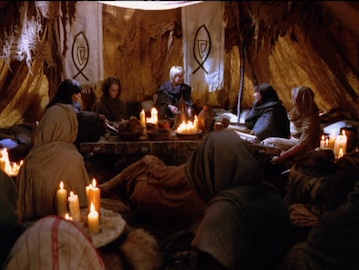
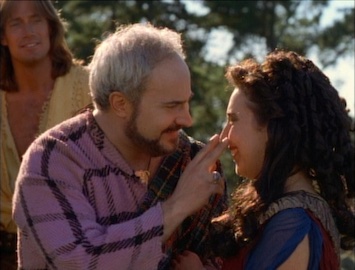
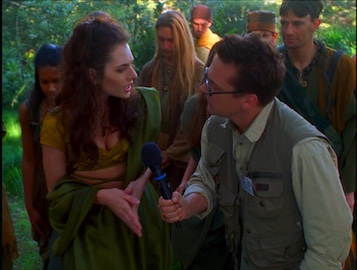
In Greece, they called him The Messenger, because they believed he was Hermes, the messenger of the gods. He enjoyed Greek theatre, & even quoted Euripides in his letters. Only half of his letters were actually written by him, & there were alterations in later years to conform with less tolerant views, so it’s hard to pin down Paul’s views exactly, but today’s scholars regard him as much more progressive than history depicts. Women were church leaders in his day: they hosted his meetings (much like the pic above) & funded them, since they also ran the households & kept the books.
When he baptized new converts, he would say: “For there is no longer Jew nor Greek, slave nor free, male nor female, for you are all one in Christ Jesus.” To the extent that he counseled obedience to Roman traditions, which he despised, it’s only because he believed he was the last generation. Had he known we’d be reading his words, he’d have written an official document for public consumption, & no doubt would be known as even more radical than he was.
Paul was a disruptive force when he came to town; like Ghandi, he was a sweet old man who could undermine the authority of the establishment, & he spent a lot of time in jail as a result.
His career began after his conversion, & after he recovered from the blindness of seeing Christ. He traveled to Cyprus, where he met a sorcerer named Elymas. Facing off against him, Paul blinded him, & won the local leader to his side. It was at that moment that Saul took on the name of Paul, from Latin, meaning “Small”, an ironic term, given his stature in history. I combined this story with the myth of Proteus to illustrate Eve’s taking on of the public role of the Messenger of Eli. Tomorrow I’ll look at how I think the Elijians can both preserve & expand #Xena’s story in a revival, & how pacifism plays a role in an action tv show.
There’s no one size-fits-all influence on #Xena, & a lot of them overlap, but The Last Temptation of Christ is one of the big ones, imo. It’s there from the very beginning of Xena’s adventure, & its presence is felt to the end. This should come as no surprise:
We know from the dvd commentary that religious history played a big role in shaping #Xena’s story, so it makes sense that landmark films like Last Temptation would be a factor. According to George Strayton, who helped craft season 5’s arc, & wrote Seeds of Faith, Rob Tapert gave him a copy of the book to incorporate into the story. It’s safe to assume R.J. Stewart got a copy at the beginning, as well, & it came in handy in season 6, no doubt. We see it in specific ways, but also as a general influence.
The whole idea of what life would be like for #Xena had she chosen a different path is there from season 1 to season 6’s When Fates Collide. The repeated motif of her crucifixion fits the story’s pattern, as well. I loved the movie, & I’ve read the book several times. Its author, Nikos Kazantzakis, also wrote Zorba the Greek (the film starred Anthony Quinn, who also played Zeus in Tapert’s original 5 Hercules movies. Last Temptation, book & movie, has attracted a lot of controversy, but the author didn’t intend that. He wrote it as a devout Christian wishing to understand the choices Christ made in his time on earth. It’s a meditation on how to regard God’s creation, the world we live in, & the transcendent divine, which lies beyond it.
He depicts Christ as being torn between the two, trying to envision his destiny in Heaven while blinded by the beauty & ugliness this world. Growing up, he feels the shame & sparseness of not knowing his true purpose, & once he glimpses it, finds the world all too beautiful, soon to be left behind.
To me, #Xena is about the struggle to realize your true self, & that’s the theme of this book. It’s a big part of Eve’s story, for me, since she has a very similar quandary, being torn between 2 very different roles & personalities. One of my favorite moments in book & movie is after Christ is baptized, & the fiery John the Baptist, who preaches the wrath of God, exhorts him to be a cleansing fire in the world. “But isn’t love enough?” Christ asks. “No,” John replies. “The tree is rotten. Take the ax & strike!” Christ, who represents a new way, can’t.
He says “If I were fire, I would burn; if I were a woodcutter, I would strike. But I’m a heart. I love!” We can hear this in #Xena, when Callisto visits Eli in Seeds of Faith, when he has his Gethsemane moment of doubt. She tells him: “The order of the gods must fall and you, Eli, are the hammer.” The most notorious section of the book is the final 3 chapters, when Christ, on the cross, considers the devil’s suggestion that he doesn’t have to go through with crucifixion to the end. It’s also significant for #Xena as well.
Just before this scene, Simon picks up the cross when Christ stumbles, & carries it for him. Simon is a tavern owner, & is known as the Cyrene. In #Xena’s pilot ep, Xena faces judgment when she visits her mother, Cyrene, a tavern owner. At this same moment in the book, as Simon carries his cross, Christ sees a vision of his mother, filled with lifelong anguish for her son’s inability to find his place, & addresses her: “All my life I toiled to turn the Curse into a blessing. I’ve done it, & we are friends now. Farewell, Mother!” This is analogous to #Xena’s relationship to her mother in the pilot, willing to be pelted with rocks if that would satisfy her judgment against her. Another key moment is just after this, when Christ utters the famous phrase: “My God, my God, why have you forsaken me?”
The book uses the Aramaic translation, & only the 1st several words, before the chapter ends, & Christ’s alternate life as a mortal begins. He says “Eli…Eli…!”
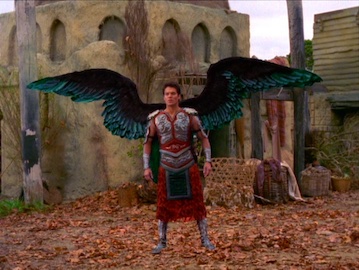
Originally, the character of Eli was supposed to be named Issa, after a pop theory that Christ went to India where he was known by that name. Rob Tapert realized that was too on the nose, & would create controversy, so he changed the name to Eli, & I’m certain it’s because of this passage. Right afterwards, Christ steps down from the cross, after being greeted by a kindly angel. In reality, he is Lucifer, & the only sign that something is off is that his wings are the color of green grass. During all 3 chapters of Christ’s alt-dream, there is this eerie presence of green. Sort of like The Matrix, how it seems to signify a deceptive reality.
(I wouldn’t be surprise if The Matrix drew this concept from the same book). For the purposes of my story, there’s a very interesting passage having to do with St. Paul. Mary Magdalene marries Jesus, & confronts Saul, the Pharisee. Because there are no Christians in this alt-reality, Saul follows his bloodthirsty ambitions, until he becomes as ruthless as Livia! He’s on a mission to kill Jesus, but Mary tells him: “I was just thinking what miracles you would perform if God suddenly flashed within you & you saw the truth! To conquer the world, my beloved needs disciples like you—not fishermen, peddlers & shepherds, but flames like yourself, Saul!” Saul says: “With love? I too want to conquer the world! In the meantime, I find relief by killing others!” Later, as an older man, Jesus confronts Saul, now self-named Paul, preaching the word of the crucified Christ. Jesus calls him a liar, but Paul laughs in his face: ‘I shall become your apostle whether you like it or not!” This version of Paul is more like John the Baptist: Love is a cleansing fire, filled with judgment.
Jesus realizes the unique nature of his message, & how he was not merely an empty vessel for God’s word, but had specifically shaped it with his gentle heart. It was to be his unique gift to the world, now denied its influence. It’s clear in the context of #Xena that Livia’s conversion by Eli was very similar to Paul’s conversion on the road to Damascus. But seeing this specific depiction of Paul, we see that Livia is very much an alternate reality version of him. As Eli’s word is spread, we see the presence of the color green.
And just as Lucifer had green wings in Last Temptation, so does he on #Xena. So does Michael & Raphael! Are they deceivers as well? Hmm, maybe there’s just more to them than we can see, but I feel the green color of the Elijians signifies, if nothing else, that we are seeing an alternate version of Christianity, one tailor-made to the themes of #Xena. Tomorrow, I’ll talk more about the real Paul, also a very interesting fellow.
One of the concerns we might have about any Eve story is what sort of Messenger she is. If we regard her as basically a Christian with the serial numbers filed off, then does that make her an Eve-angelist? Does she travel to other countries looking to convert “pagan” souls to her faith? Is she a cultural imperialist, a zealot, preaching the one true message of the one true god?
I think we already have our answer to this in The God You Know, in the very last scene. Eve, Ares & Aphrodite are all sitting next to each other, with Eve smiling sympathetically as Dite complains about her newfound mortality. She’s sitting right next to Ares, with whom she had some bad history, but doesn’t seem to mind. He did bring her back to life, after all, in Motherhood. Later on, Eve has no problem when her mother restores their godhood to them.
It doesn’t surprise me that Eve & Dite get along: they’re in the same line of work, as I see it, just working different sides of it. They’re spreading the word of love, & I believe Dite has a bright future, in her own way. Ares, as well, since he’s highly adaptable & probably the most open minded of the Olympians, given his opportunism. We shouldn’t be surprised. This is how it worked in real life. These Olympians continued on side-by-side with the Christian faith, & survived into the present as motivators of human interest in their respective sphere’s of influence. Love & war did not end with the Christian Era, & certainly not with the Elijian era.
So, what IS the Elijian Era? How does it work, according to the show? How is it different from the Olympian era?
The bottom line is: pretty much the same! If you go back & highlight everything Eli says about his faith, it’s pretty much a description of what Xena & Gabrielle already believe. It’s the ethos of the show, presented as a religion.
Eli never talks about having rituals, or having to believe in a particular god (despite there actually being an entire heavenly hierarchy associated with this faith). There don’t seem to be any jealous gods demanding fealty, or holy days, or anything like that. In fact, nothing to preclude one from leaving any other faith to join it. In Seeds of Faith, Eli does say that humanity doesn’t need the gods. He teaches that each person is potentially a vessel of love that can find peace on their own.
This makes him a threat to the jealous Olympians, but Krishna doesn’t seem to have a problem with his teachings. Indeed, Eli was a student of the Temple of the Chakram, which presumably was set up by the elder gods, & we’re told by Chris Manheim that he traveled to Egypt as well to study there, so there seems to be a connection of truth among all these faiths that he’s tracing.
I think the roots of Eli go deep in the show’s creation, all the way back to its original concept as an adaptation of Conan the Barbarian. In those stories, there is a similar figure, Mitra, who is different from the others. He is a kind of humanist god, appearing as a gentle, bearded man, who empowers & elevates humanity, rather than try to reduce it to a groveling & bestial race.
But Eli’s teachings come straight from Greek drama, I believe. #HerculesTheLegendaryJourneys was heavily influenced by Euripides’ drama, Herakles, I believe. It’s about Hercules’ reputation being destroyed by Hera, & redeemed by the faith of his friend, Theseus, who stands by him when all others have turned way. This act of unconditional friendship is key to the show, & I believe key to #Xena as well. The very last ep is called A Friend in Need, after the Aesop fable about true friendship when it’s most needed. In Looking Death in the Eye, Ares laments #Xena’s “death”, envying Gabrielle’s unconditional friendship, while acknowledging that his own is quite conditional, indeed.
This doctrine of unconditional friendship is the true creed of Eli, & he demonstrates it when he saves his persecutor, Livia, & restores her to her true self, Eve. You might say there’s a condition: Eve becomes his Messenger, continuing his ministry, but that’s how she rolls. She never does anything by half measures. The theme of friendship is the message that I believe Eve takes up. As Eli says in Seeds of Faith, “If we are joined in peace & friendship, then we have no need of the gods.”
Ares: “Since the beginning of time, it’s been warriors who have shaped the world!”
Eli: “That’s about to change.”
—Seeds of Faith, #Xena Warrior Princess
This week I want to tackle the subject of Eli & the Elijians, the followers of his message.
He died a martyr for preaching peace, slain by Ares so that the cause of peace would live on after his death. I think it’s a relevant story to our times, especially for anyone looking to change the world in a real & lasting way, & why it moves me to write about it.
To me, it’s not just something they came up with for season 5. I maintain it was there from the beginning: literally, the pilot. For that reason, I think it’s an integral part of any future Xena/Eve story. But I don’t think this is something I can fully argue in a few posts.
So I’m not going to go into great detail litigating this issue here. My main goal is to provide my rationale for using the Elijian storyline as a focus for my story, & explain why I think it should continue. My goal is to create what I think a canon Xena story should be, and not to prosetylize on behalf of any specific religion that Elijianism is seen to represent. According to the writer of the above ep, Seeds of Faith, Eli is inspired by both Christ & Ghandi, but shouldn’t be read literally as one or the either. I think the Elijian cult has a number of ingredients to it which I will briefly outline, & I’ve taken the stated sources used on the show & expanded on them as a way of giving a more thorough picture of the cult in my story.
Since my story is set after Motherhood, over 25 years after Eli’s death that’s plenty of time for rituals to develop, & indeed, we see Eve take part in one at her initiation: baptism. There’s also time for growth of dogma, for legends about Eli to arise, & misconceptions & schisms in the faith. We see the beginnings of that, too, on the show.
Mostly, though, I want to address any skepticism fans might have about the dramatic potential of the cult of Eli & its impact on an action show like #Xena. His teachings sound like a wonderful ideal, but maybe not entertaining to watch.
Myself, I’m fascinated by the growth of religions, & the pacifist approach as a subject of drama, so I feel perfectly suited to tackle this difficult subject in what I hope will be an entertaining way. This week I’ll be discussing the show’s sources for Eli’s story, how Eli’s teachings mesh with the ethos of #Xena, where Eli’s name came from, Eve’s real-life model, St. Paul & how he’s viewed today, how pacifism works, & why Elijians like green! I’ll end the week with a music video of what I consider to be the perfect Elijian anthem.
Let’s talk some more about #Salmoneus, who’s quite entertaining, but a really interesting character, the closer you look. His character is often associated with blindness, or lack of insight, his own, or other folks. In Eye of the Beholder, he stands with a cyclops who’s discriminated against because of his height. A contrast is made with the single-eye cyclops & the blindness of the country folk who can’t see past his appearance. In The Gauntlet, he sees the potential goodness of #Xena before anybody else. He tells #Hercules: “She’s not as evil as you think she is. She’s got some heart!” Hercules is skeptical: “You’re serious?” Later, Sal tells #Xena she should be teaming up with Hercules against their common foe. BTW, Sal even tells us #Xena’s scent, in Unchained Heart: “Hyacinth & cinnamon”.
So his nose is perceptive, too! He does a number of eps related to blindness. In season 3’s Lost City, he’s blinded by a type of lotus leaf, & the same is true in All That Glitters. That saying, about gold, is also about not judging the worth of something by its appearance.
I used All That Glitters as an important source for my story, because I believe he meets his future wife on this show. Sal, a former toga salesman, shows off his latest custom-made toga in gaudy colors, & Herc responds: “Are you color-blind?”
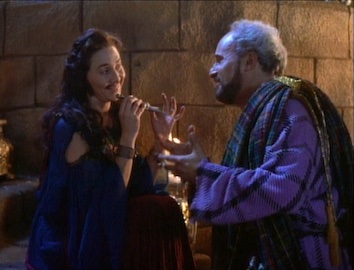
Sal & Herc visit King Midas to see his new gambling casino, The Golden Touch. It turns out, the king lost his golden touch, & works as a greeter. He lost control of his kingdom to a couple of venture capitalist sharks, & now they’re running it into the ground, with predatory lenders & gambling destroying its economy. At 1st, Sal is blinded by gold: he’s impressed they’re making money hand over fist, however unethical. The casino’s predatory queen, Voluptua (played with relish by Jennifer Ward-Lealand) catches Sal’s eye with her dress & business sense: “What I could do with a partner like her!” Later, Sal is approached by Hispides, a bearded lady. If you’re wondering what the deal with that is, the casino has a distinct circus atmosphere, with flame throwers, trapeze artists, etc.
I suspect the reason has to do with an apocryphal phrase attributed to P.T. Barnum: “There’s a sucker born every minute.” Barnum introduced the bearded lady at his circuses, & they were mostly the real thing. Bearded ladies have a genetic trait that is distinct from intersex or transgender people. Hispides has a mustache & a beard, & approaches Sal with what sounds like a pick-up line: “I like your toga.” Given the established fact of his toga’s garishness, Sal definitely interprets this as a come-on, & focuses on his dice.
She tries to approach Sal several times, after removing some of her facial hair, but he’s brushes her off each time. The action comes to a head when Hercules desperately needs a knife to cut the rope trapping King Midas & his daughter. Sal tries to find one.
Turns out, Hispides has a knife, presumably the one she’s been shaving with. Now coyly filing her nails with it, she agrees to sell it to Sal for a fair price. Sal agrees, & Herc is able to save the day. The kingdom gets its native economy restored, & the casino is shut down to be sold for parts. Hispides now corners Sal once & for all, her face totally shaven. Sal is stunned with her fetching appearance (in his eyes). “Oh, you like it?” she asks. She quickly shifts the topic to what she’s been trying to talk to him about.
She wants his help to buy the casino parts cheap, & resell them at a marked up price. Suddenly, she’s even more beautiful to Sal, & they fall deep into discussion, as Sal begins to see the benefits of delayed gratification as an economic principal.
My guess is that Hispides’ whole agenda throughout the ep was to size up the casino as a potential opportunity. She probably realized it was an unsustainable business model, & posed as the bearded lady so she could get an inside look. She spotted Sal, game recognized game, & it was business at 1st sight! For her, at least. She was willing to blow her cover to get his attention, & saw through his silliness & found something more substantial. I don’t think it was necessarily love at 1st sight, since Sal would go on for several more seasons as a satyr on the make. But in my alt-universe, she & Sal hook up again in the middle of season 6 of #HerculesTheLegendaryJourneys with an arc of their own, as they attempt one business venture after another, each crazier than the last, until they find their pot of gold, metaphorically speaking, that is, culminating in a clip-show wedding ep of legendary proportions.
I like them as a couple because she’s well-suited for him, & is equally attractive to his non-satyr side, & I believe she’ll strengthen that quality over time. Plus she’s the type of gal that he’s qualified to actually make her dreams come true: he’s the salesman that can bring her schemes to life.
My #Xena story covers not only events on Earth, but in Olympus as well. Aphrodite finds herself the queen of Olympus. This is not the 1st time! On #HerculesTheLegendaryJourneys Aphrodite’s alternate self in Stranger in a Strange Land is not the goddess of love (that’s Ares), but the queen of Olympus. Hercules’ alt-self is The Sovereign. I love this concept because Earth’s Herc is defined by friendship, but the Sovereign believes he needs no one (one of the meanings of the word “sovereign”). Queen Aphrodite is being forced to wed him to save Zeus’s life.
Xena and Queen Aphrodite
Her wedding dress is black, as if she’s in mourning. This is a nice coincidence, because the Queen Aphrodite in my post-Motherhood story is still dressed in her black mourning gown, in honor of the fallen Olympians killed by #Xena.
Aphrodite in mourning, in Motherhood
She’s also mourning her old role as simply the goddess of Love. Running Olympus on your own is not all it’s cracked up to be. We never actually get to see her in this role on the show because we don’t see her again until The God You Know, in which it turns out she’s under the thumb of up-and-coming god Caligula. So, in a way, the 2 queens have a lot in common! Aphrodite doesn’t get her godhood back until You Are There, at the same time as Ares, & when we see her next, in Many Happy Returns, she’s back to her cheerful self, ruling Olympus with her brother Ares sharing the burden.
One of the biggest things to address in an Eve-centric story is figuring out what she does. What is the message she delivers? What is the purpose she serves? She’s not just looking to do penance, she’s on a mission. That meant defining the God of Light, understanding Eli’s message, & looking ahead to see what sort of problems she’s uniquely suited to fix.
I’ve noticed a lot of Eve-related fan fiction avoids this issue by taking Eve off her path as Messenger, by having her discover the cult is corrupted in some way, or she becomes disillusioned with it, & returns to Xena’s original path for her, the Amazons. I’ll talk more about this next week, but I think the most feasible path for her is that of the Messenger of Eli. Among other things, this gives her the opportunity to engage the word at the same scale #Xena did, in a way that an Amazon or a wandering pacifist doer-of-good-deeds would—& she would have to be a pacifist: returning to violence would be a defeat for her character, & very difficult to justify, & there’s no way the former Livia would not be challenged everywhere she went, unless she had a pretext for not responding with violence, & the stature to enforce that. After all, St. Paul was a former practitioner of violence, & was protected from retribution by a church that supported his efforts.
Plus, the idea of Eve going it alone goes against her character. She’s not like her mother, a ronin-style wanderer. She’s spent her life in a community & thrived in that, & we see her building a new one for peace throughout season 6. Being part of an organization is more her style. That said, she has the instinct of an iconoclast, someone who upends tradition & bucking the status quo for what she thinks is right. The community is necessary, but she’s not afraid to defy it, especially in the form of the Roman government.
Essentially, I see her role as a uniter, someone who brings people together, & her organizational skills makes her a perfect recruit for Eli’s mission. Eli himself was a bit of an anarchist, a student who took to the streets driven by his beliefs. Eve thinks on a much higher strategic level, & like Paul, has the temperament for turning a cult into an empire-wide force. But that is yet to come for Eve. It helped me to imagine her arc through season 6 & beyond, into a future spin-off, & work backwards from there. Her casual gestures in this story would one day be seen as humble signs of the legends to come.
Next week, I’ll go into more detail about this Elijian faith she serves, to understand what exactly she’s fighting for, & how we’re to think about it. Is it idealistic, practical, foolish? Or is it an imperialist, colonialist, nationalistic form of evangelism that most Xena fans would have difficulty rooting for? Spoiler alert: most fans should be okay with it, as I understand its workings.
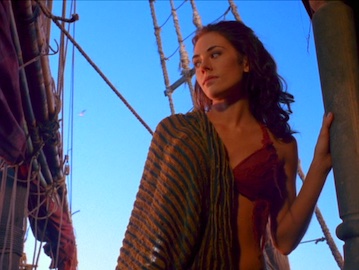
I chose this thread’as picture of Eve on a ship, gazing at the horizon because that’s how she 1st appears in my story (though looking much more frazzled), wondering about her future. She lived her life focused like a deadly laser beam, & now that beam has dissipated in the clouds surrounding her, the future a blinding haze yet to reveal the path forward. This week’s music video is not in the story itself, but is the song I listened to first each day as I worked on this project, & helped get me into Eve’s state of mind at this moment. Its images eventually became woven into the fabric of the story itself.
There is an old saying: “Dying is easy, comedy is hard.” I guess it depends on the circumstances. My preference for this story was to make it a musical comedy, the format I have the most fun writing. That said, There are issues involved in this story that make it tricky.
This story revolves around Eve’s coming to terms with her past in order to face the challenge of the present: the threat of citywide violence, crucifixion, & the destruction of the Elijian cult she’s just joined. Not the stuff of comedy, you’d think!
At the center of this story is Eve herself, who had no comedic lines on the show (outside of the You Are There parody). Furthermore, comedy eps on #Xena always had a serious subtext. In fact, some of them were originally dark dramas, flipped to comedy for various reasons.
In order to acclimate myself to this challenge, I did a number of things. First, I wrote it as a serious drama. It helped me to take the story’s issues seriously, & to bring in characters from the original show on an equal footing. I added layers of comedy to their scenes once I was certain I had a good grasp of the drama. Some were very easy to convert to comedy. Both #Xena & #Gabrielle had a history of comedic performances, so I had a good feel for their style. Ares & Aphrodite were the comedic relief, so it was more a matter of adding deeper layers to their story than the other way around.
Salmoneus would seem to be easy, but he has a unique style that can get quite meta, so it was more a case of trying to channel #RobertTrebor’s sense of ad-libbed humor. I read his recent book of political satire #TheHaircutWhoWouldBeKing which I very much enjoyed, so it helped me get an idea of his voice independent of the show’s writers. Sal’s daughter was a bit trickier, since hers is a more dramatic role, but she shares some of Sal’s traits & manic energy, which was helpful.
Eve was the most difficult of all, & in fact, her story got darker the longer I worked on it. Her life’s an amazing journey, & I explored as many of its emotions as I could, but it didn’t fit the story tonally. I reviewed as many of Xena’s similar episodes (such as Locked Up & Tied Down) to get a sense of how the writers & Lucy juggled her darker issues with the energy of her action scenes & comedy (which is present in every ep, no matter how dark), & that helped me find an approach.
As it happens, I have no trouble imagining Eve’s sense of humor in a future revival/spin-off. There’s another saying: Comedy is tragedy + distance, so a revival would give Eve decades of distance. But this story is set only days after Motherhood, between 2 tough eps for Eve so it’s hard to figure out where Eve’s sense of humor is at this moment. The writers themselves couldn’t figure it out, either, it seems; earlier drafts don’t show any humorous lines for her. I don’t blame them. As I see it you can’t write comedic lines for her unless you know exactly where she is at this moment, & I don’t think anyone really did.
It seems to me that Eve’s character was in flux during this time, & her backstory not really known by anyone. Adrienne made her own backstory, but it had to be revived constantly as new scripts with new surprises about her past came up. Actors were encouraged to improvise (& she did for You Are There) but Eve wasn’t a character that lent herself to that. Perhaps Eve’s status as a religious leader like St Paul meant they had to tread carefully with her.
That may explain why Eve’s first comedy scenes wait until her 2nd to last appearance. Eli himself didn’t have any real comedy scenes either despite being a street performer. So the challenge for this story is clear: to give Eve comedic scenes, there needed to be a logical psychological framework for it, & that required a clear backstory to shape it. Once I did that, her comedic lines felt more authentic to me, & her point of view actually helped shaped the visual look of the story, over time.
Though I tried as often as possible to imitate the look of the show, I decided to customize that look to integrate it with Eve’s sense of humor, & allowed her to respond more organically to it. We’re seeing the world through her eyes, so I believe it feels more genuine. I feel this is in keeping with the show’s spirit since it often customized locales & costumes to give each town its own look, so the townsfolk & Roman soldiers of Cyprus would also have their own look as well. Cyprus does appear on #HerculesTheLegendaryJourneys & does indeed have its own look, but I’ve taken that idea further, borrowing some elements while setting the action in the northern sector of the city, near the ports & canal district, whose influences are more Asian, Egyptian & Indian, more connected to global trade. There’s no visible Greek influence, of course, in keeping with the show’s aesthetic.
It was a lot of fun exploring this side of Eve, though it was a gradual process, but I was able to pull from the original show opportunities for humor that were left unexploited, & of course Adrienne herself has a great sense of humor, so I feel like I’m staying true to Eve’s experience.
A big issue for an Eve fanfic writer is translating Eve’s character from a supporting character to main character. In my story, I carve out space for Eve to have enough independence from Xena so that she can emerge on her own.
Eve is quite a formidable character: she had expanded Rome’s empire, nearly became its empress, was feared by the ruler of Hell, her blood has the power to make the infernal incarnate, she can see into people’s hearts, literally, & is willing to go toe to toe with Lucifer & Caligula without batting an eye. Then she talks Emperor Claudius into sending a peace mission to the very Amazons who’ve vowed to kill her if she returned, & this is just getting started! She did this without friends or soulmates. She has her mothers, & she has the love of Eli, but these make her dependent, in our eyes, important as they are.
As I see it, though, it’s all about framing. In The Gauntlet, Xena is a villain, but she transitions to being a hero. Part of that process was the traveling salesman, Salmoneus, who saw her good qualities before anyone else, thanks to his keen sales instincts. He offers to become her publicist, which sounds silly, but it’s what every good hero needs when they’re establishing themselves. And for Xena’s pilot, she indeed gets her own publicist, in the form of aspiring bard, Gabrielle. That entire 1st season has Gabrielle talking up Xena non-stop. Eve doesn’t have this, but her evil counterpart, Livia, does! Livia gets a triumph in Rome, a salute by Caesar, thanks of the Roman people, makeout sessions with Ares, the works!
Eve really only gets one outright endorsement, of sorts, & it’s from Mephistopheles, lord of Hell! Everyone else greets her with yawns or sarcasm, o r the odd blow to the head. True, Livia killed Joxer, which should’ve hurt her likability with the audience, but it’s Eve who apologizes for it, making her look weak—in entertainment terms, of course. Objectively, Eve is the stronger of the 2; she has to juggle a lot while on very shaky ground, while Livia is a tragic figure who’s vulnerable to Ares’ whims & treacherous Roman politicians.
Eve does very well: she only backslides once, when her mothers seem to withdraw their support, in Heart of Darkness, but she bounces back quickly. So the challenge for Eve fanfic writers is to give Eve credible publicists, & chances to express her strengths through action.
I’ve no doubt that the Eve spin-off intended to do these things, most likely in the form of disciples constantly defending her, & strong opponents overcome by her. I think we already saw one of them on #Xena: Archangel Michael clearly resented Eve, & it’s hinted he resented Eli, too. The exaltation of all these humans into the ranks of the divine hierarchy must’ve grated against his angelic sensibilities, & I suspect that was set up to be developed on Eve’s own show.
The earlier drafts of The God You Know depict Eve as much more subject to manipulation than we saw, & I suspect it was removed because it made her look weak. It would be around this time that the producers would be thinking of a spin-off,& you can’t be weakening the lead character like that. Instead, it now looks like Eve was betrayed by Michael, but not fatally, & would be much the wiser around him in future. Eve’s faith in Eli wasn’t fatalistic, but decisive, & we can assume that it was rewarded, after all, in spite of Michael.
So, you have to be a bit of a salesman, like Salmoneus, to sell a hero, & that’s one of the reasons I felt he’d be a perfect guest star on an Eve-centric ep!
Literally speaking, Eve is the redeemed spirit of Callisto, reborn by choice as #Xena’s child. Reincarnation is part of the Elijian cosmos on this show (as it was among some early Christians). That said, there’s an interesting line that gets overlooked in that ep, “Seeds of Faith,” in which #Xena, who doesn’t trust Callisto’s new perspective, dares her to get off her angelic high horse & try living in the real world again. I wonder if this put the idea in Callisto’s head to accept this challenge, deciding to be reborn as her child?
If so, this casual taunt of #Xena’s sets in motion some amazing events for the rest of the series, not to mention, endanger Callisto’s salvation when, as Eve, she gets separated from her mother & reverts to her warlord ways. This also leads to some interesting layers in Xena’s & her child’s relationship, as adults. Though they don’t know each other, after 25 years separation, still, there’s the unusual bond between Xena & Callisto that surely must exist. In a sense. Xena is the mother of 2 people: Callisto & Eve; quite a burden.
This is the final shape of Eve’s origin, but it took a while for the writers to arrive at this, given that the show changed hands during this period between its temporary show runners, & the return of R.J. Stewart from running the spin-offs. Preliminary plans were made, perhaps from Rob Tapert’s notes, I’m guessing, for Eve’s birth, the Twilight of the Gods, & finally, the 6th & last season. Some of these were kept, but a fair amount of Eve’s story was dramatically revamped.
Originally, Eve as Livia was intended to continue on through to the end of the show. She would pursue Xena & Gabrielle as Caesar’s queen, while the heroes fled Greece much like they did in season 5 from the gods, under different names. A final confrontation in the series finale would end with Livia realizing who she was, and Caesar beginning the Pax Romana, the Roman Peace. I’m glad they didn’t do this. It’s the equivalent of Gabrielle’s descent into madness in The Play’s the Thing, turning a show about peace into a bloodthirsty crowdpleaser, destroying the message in the process.
Rob wanted Livia to last only 2 eps, ending season 5 with Eve’s return, so a different idea was proposed: Livia corrupts Caesar & tries to get Ares to build a siege engine that shoots firebolts (which sounds to me very much like Ares’ unsuccessful 1st appearance on #HerculesTheLegendaryJourneys ).
It also reinforces an unsavory idea (to me, at least), by blaming Livia’s evil on her innate evil qualities inherited from Callisto’s spirit. The writers saw it as Callisto’s karma she had to work off, but that doesn’t make sense to me: would an angel carry bad karma? Of course, in the dvd commentary, both Rob Tapert & R.J. Stewart suggested this was so, but this is a rare moment when I think the writers got it wrong. I think Adrienne Wilkinson got it right when she attributed it to Livia’s upbringing.
It’s the most logical conclusion, & no surprise, since she would have to make logical sense of the role with her performance. This is also how I interpret Livia’s downfall, & I’ll talk more about this next week, when I discuss the Elijian philosophy.
These are story details, but the overall arcs also help shape Eve’s origins. There’s the Child of Destiny, i.e., the Rosemary’s Baby motif, that culminates in Eve’s story, but there’s also the series-long teasing of the coming of the One God to replace the Olympians that is fulfilled with Eve’s character. But there is another motif as well: the Dionysus motif, which is strongly associated with Xena, but finds full expression with Eve, as she most resembles, more than anyone, the character of Dionysus in The Bacchae: the stranger who brings the new disruptive faith to town, & leads to the undoing of those who refuse it.
There are hints that Eve fits this pattern in her names, as well. It was Chris Manheim who originally gave her the name Livia, taking it from the BBC series, “I, Claudius,” & the matriarchal figure from The Sopranos. But I notice she was referred to as Lydia in one of the early drafts, making me think this was a placeholder name, which I believe was taken from The Bacchae: Dionysus declares he has arrived from his home, Lydia.
Eve’s name has several roots, I believe. Paradise Lost was one of the sources that was required reading at this stage of the show, featuring Adam & Eve at the center of a war between Heaven & Hell. Another, I’m certain, was Aristophanes’ comedy, The Women’s Festival, which refers to Dionysus by his other names: Evius, Evivus, & Evoe. I believe The Women’s Festival was used as a source for a number of Xena episodes, including Kindred Spirits, which is where Xena took baby Eve to protect her from the gods. But there’s one more major factor to Eve’s origins I believe we should look at.
Over at Hercules, as Xena was airing Adventures in the Sin Trade, in which Xena is separated from Gabrielle by death, there is a similar, but longer arc on Hercules, in which Herc is also separated from his friend Iolaus. That arc is much longer, & explores that idea much more fully (due to Herc having more flexibility in its format: Xena fans would not tolerate Gabrielle being out for an entire season).
At one point, Hercules goes to Ireland, where he meets a group of druids who are very similar to Elijians: they’re a new religion, threatening to the old gods’ order. They send an assassin, Morrigan, to eliminate the druids, but she quickly discovers that when she kills the Druid of Justice, she must take his place. It’s a role that’s completely opposite to who she is, & the very idea of it makes her ill. Hercules is the mediator, the one who provides exposition by asking the druids how this all works, then talking to Morrigan in her now-weakened state, since she can no longer drink the blood that sustains her.
This is a full season before Eve’s story, but it’s very similar; in fact, it gives us a few more story beats to Eve’s story, should we want to extend it, & that’s what I’ve done in this project, using this idea of Morrigan trying to adjust to this new life of justice & peace, feeling very unsuited to it all, but finding her motivation in the end.
I think this beat is missing in Eve’s story, & can help provide background should we wish to expand on her story further. There’s one more building block to consider, & that’s the biblical source of her story. When Motherhood originally aired, it was immediately recognized that Eve’s story matched St. Paul’s story, in the New Testament Book of Acts. His conversion from persecutor of Christians to their greatest champion is clearly a model for Eve.
I will address this more next week, but I believe she is not just modeled on a generic idea of Paul, but on a very specific literary depiction of Paul that will shed light on her & the Elijians. Understanding these sources was key to how I approached this project, as well.