It’s been ten years since I first started writing essays on Xena, Warrior Princess, analyzing the show’s elusive aesthetic approach, and I’ve been out of the fandom since, but I had recently stumbled on the possible solution of a fifteen-year-old mystery about one of the Xena episodes. While researching it, I thought I’d look around and see what the Xena fandom was up to these days. As it happens, there’s renewed interest in the show by several podcasters, thanks to a possible reboot. Two of them I’ve begun listening to with interest:
Xena Warrior Podcast is hosted by three film school graduates, and they bring a keen eye to the technical accomplishments of each episode. They can spot the writing and directing techniques that would be important to the people making the show, but which may not be obvious to the rest of us. They watch each episode several times while taking notes, and I make a point of taking notes during their podcasts because they catch things I’ve missed, or never knew in the first place. When they don’t know something, they raise very good questions, which I’ve found are good to follow up on (some of which I’ve tried to, below).
They also do a very good job of tracking character development, and because they’ve studied screenwriting, they can spot how the writers strive for consistency among all the seeming chaos of this unpredictable show. They have a good eye for story framing and foreshadowing, and they’ve talked about the show’s remarkable consistency, with which I very much agree! Whether or not you find my own take below convincing, they make a compelling case for taking Xena seriously as an underestimated, well-crafted series.
Xena Warrior Business is a lively podcast hosted by Chris Sims, comics writer, and Alison Stock, and include a variety of guests in their line-up for different points of view, and they’ve called out some interesting things on the show I’ve overlooked. Not long ago they had Javier Grillo-Marxuach himself, who had been involved in the most recent Xena reboot project, discussing his own approach to reimagining the Warrior Princess (I’ll talk more about that in another post). A frequent guest is Dan Cassino, who writes The Dan Scrolls for their Patreon account, an informative and surprising look at the mythological foundations for the show’s stories. From what I’ve heard so far, he’s provided an intriguing take on how the show’s version of Greek myth compares to actual Greek myth, and provides suggestions on how the myths can be used to help understand and enhance the stories, and even suggests ways to augment the stories using rationales from the original myths. This is the sort of thing I love! Dan has also talked about how the show is actually far more consistent in its use of myth than we would otherwise think. I agree wholeheartedly!
I’ve been catching up with both podcasts, and not long ago, heard them discuss two Xena episodes that are not considered among the show’s best: Blind Faith, and Ulysses. One of these is based on myth, though not the way we’re used to, and the other doesn’t seem to be based on any Greek myth at all. They both seem to work against our expectations not only of ancient Greece, but how Xena should relate to them. In my experience, it’s where the show seems to go off its game like this that you can discover a lot about its process (I’d say this is true of any work). As good a job as both these podcasts do, it’s difficult to understand fully how these two episodes work without understanding their “logic of aesthetics,” as Rob Tapert would say. Once we do, we’ll see that both episodes actually are derived from the same myth, one which is repeated throughout the series!
Before we begin: Please keep in mind the following is not about the “secret meaning” of Xena,Warrior Princess. Everybody knows what the show’s about. It’s very accessible, by design. But the way it’s told, it’s “aesthetics”, as I’ve describe it, is not so easy to figure out. Again, that’s true of any creative work].
We can’t talk about the show’s aesthetics unless we’re willing to consider there’s some kind of strategy at work, at least to a certain degree. To do this, let’s keep a few points in mind:
- Rob Tapert has stated that he used Robert Graves’ The Greek Myths as his unofficial show bible, and that the Xena staff was asked to be familiar with it as well. Graves believed that what we now know as Greek myth is actually the misunderstood remnants of an ancient matriarchal society whose history is now lost. This gave the show’s creative team a unified take on the myths they selected and how they were used.
- Rob played a large role in the shaping of each episode; along with show runner R.J. Stewart, they came up with 90% of the episode ideas, and Rob often supplied a brief summary of each episode for the writing staff. He also supplied reference materials for each episode, including books and videotapes. This approach allowed for the possibility of a consistent aesthetic language to be developed and managed, regardless of who wrote the teleplay.
- Showrunner R.J. Stewart, like Rob Tapert and Sam Raimi, is a writer experienced in using references and templates from movies, tv, and literature as a basis for his stories. He was story editor on Remington Steele, a show that shaped each episode around a classic Hollywood movie (since the main character was an actor posing as a detective). R.J. also grew up in Greece, and is familiar with Greek myth and theater, and used Greek plays as often as Greek myth on the show. He either wrote the teleplays, rewrote them, or gave extensive notes on all of them before they went to final draft.
Both podcasts mentioned confusing or problematic (!) issues with the show that I believe can be addressed by examining the show’s highly referential aesthetic approach. Here are some issues they raised in their podcasts featuring Blind Faith and Ulysses:
Blind Faith: Why is the boy called “Palaemon”?
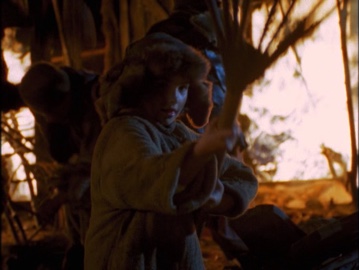
Consulting the show’s chief source, Robert Graves’ The Greek Myths, we’ll see that Palaemon was Hercules’ name before he became famous. In the myths, the hero formerly known as “Palaemon” took the name Hercules after he did penance for killing his family, with his friend Theseus’s help. This is a key point for this show, because it’s a reflection of the overall mentor theme in Hercules and Xena. Again, consulting The Greek Myths, this idea of a young awkward upstart idolizing a hero appears to be based on the story of young Theseus, who idolized Hercules and sought to emulate him. As a child he instinctively tried to attack Hercules’ lionskin, thinking it a real lion. References to this can be found throughout Hercules (in Centaur Mentor Journey), Xena (in Adventures in the Sin Trade), and Young Hercules, to name a few. You might remember Otere as a child improbably challenging Xena in Adventures in the Sin Trade, causing Xena some alarm, since she was told Otere would inherit her powers one day:
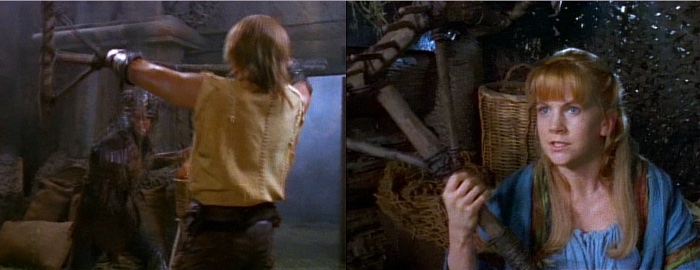
In fact, Xena Warrior Podcast mentioned what I think is a good example of this in Xena‘s first season episode, Prometheus. During a fight scene, both Gabrielle and Hercules pick up rakes to protect themselves. Hercules swings his like a mallet, while Gabrielle looks on from the sidelines with hers, living vicariously through him and Xena, not yet able to fight herself. R.J. Stewart wrote this episode, so if this was indeed a minor motif, he would have likely wanted to incorporate this visual reference with Hercules guest-starring:
Palaemon is aptly named because, like both young Hercules and Young Theseus, he seeks fame, and is brash enough to take on anyone. There is something that separates him from those heroes, though. His blindness. This is an important clue to the episode’s source. I’ll talk more about this in the Greek Myth section below.
Is Blind Faith about “toxic fandom”?
Palaemon’s interest in Xena, and his vast knowledge of her background, is interpreted by both podcasts (particularly Javir Grillo-Marxuach) as a portrait of “toxic fandom.” This is understandable, because the show does occasionally depict fans as a bit unhinged in their devotion. Not in this case, in my opinion. Part of this is explained above, but there’s something more:
Xena Warrior Podcast mentions how this episode seems to contain Western tropes, and Palaemon in particular resembles the classic young gunslinger who wants to become the best by taking down the best in a duel. Exactly!
But this episode isn’t merely borrowing a trope in general; it’s inspired by a specific use of this trope in a film that is focused on reexaminations of Western Tropes, starring Clint Eastwood: Unforgiven.
Eastwood, famous for his spaghetti western character, The Man With No Name, is an inspiration for Lucy’s portrayal of Xena, no doubt, but this episode borrows another character from this particular film: the Schofield Kid.
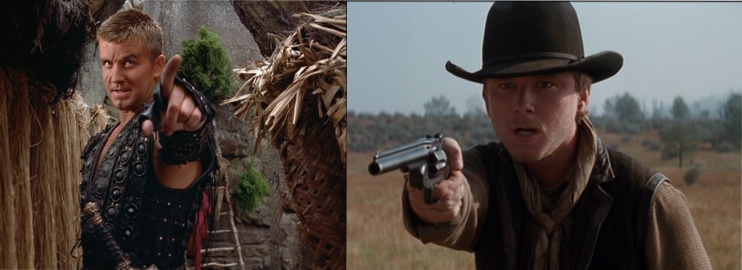 Jeremy Callaghan as Palaemon; Jaimz Woolvett as The Schofield Kid
A boyish gunslinger who tags along with Eastwood’s character in Unforgiven, he boasts he’s better than any of them, and has little patience with his more experienced traveling companions, whose gentle demeanor disgusts him. It turns out the Schofield Kid is sight-impaired. He can’t see anything unless it’s right in front of him. He’s all talk, and when he discovers just how ruthless Eastwood can be, he wants no part of the gunslinger mythos.
If the title, Unforgiven, rings a bell, it should: next season there will be another Western-inspired episode, Forgiven, also involving a young person who wants to supplant one of the principle characters, this time Gabrielle. This episode will much more clearly signal its Western influence by ending with a shot inspired by the ending of one of the most iconic shots in a Western film, The Searchers: Xena framed by the doorway, unable to enter the house of forgiveness, just as John Wayne, the uncompromising frontier scout, was unable to join in the reunion of the family he brought together. We will see The Searchers referenced again, later in season four, in the sequel to The Price, Daughter of Pomira, which features yet another young gunslinger scenario. And there’s a link to another episode of Hercules, towards the end season 5, in Fade Out: Hercules says: ”We are who we perceive ourselves to be.” This recalls what Xena says in Blind Faith: “We all eventually become what we pretend we are.”
Are there any Greek myths used in this episode?
I think there’s no doubt, and blindness is the clue to the myth being used. It is the story of the Cyclops, and not just any version, but specifically, Euripides’ play, The Cyclops. This play is the only extant ancient Greek comedy to survive, and it combines many of the major metaphors for both Hercules and Xena. Any time you see the idea of blindness (metaphorical or real), sight, eyes, megalomania, Cyclops (including any single-eyed or third-eyed characters), pirates, caves, intoxication, or silly characters resembling satyrs in spirit, you’ll find The Cyclops is the underlying influence and organizing principle. Indeed, this episode is tied in with the following episode, Ulysses, both in story and theme.
Using Euripides’ The Cyclops proves a highly unifying writing tool for a show that often seems to be all over the map, given its unconventional remix of myth and history. It combines comedy, tragedy, and epic drama, and they can often be used in ways that are not immediately recognizable. Looking at Forgiven, once again, we’ll see the pirates of The Cyclops appearing in the form of the Cilician traders looking to buy the stolen Urn of Apollo (The Whoosh transcript says “Silesian” traders, but I assume this is an error: Silesia is a medieval German district; Cilicia is the land of pirates in the ancient world, and we see Xena playing a Cilician pirate in Destiny, not to mention their appearance in Spartacus, referenced numerous times on the show). Forgiven is another story about blindness, escape and finding one’s place in the world.
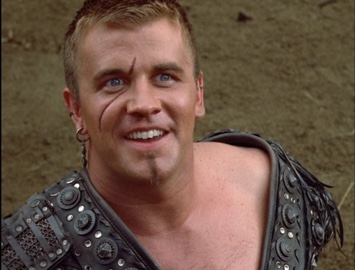
We have visual evidence that Palaemon is playing the role of the single-eyed, single-minded braggart, because he wears the mark of the Cyclops for all to see, a slash across his right eye that has just nearly missed leaving him with one eye. We can see on his boyish face everything we need to know about his backstory, why he’s so determined to be the best, and why he’d want to make sure nobody ever got that close to him again. This is a frequent visual motif on both Xena and Hercules: we’ll often see characters with unique eye-patches or make-up involving one eye.
Ulysses: Why was Ulysses called Ulysses, not Odysseus, in this episode?
And while we’re at it, why did they portray him the way they did, and not like the hero of the Odyssey as we remember it? Was he simply miscast?
We can find the answer, once again, in The Greek Myths. Robert Graves ends his two-volume series with his unusual interpretation of The Odyssey. He cites the theory of nineteenth century author Samuel Butler (author of Newhon), in which he speculates that Homer did not actually write The Odyssey; it was instead written by a Sicilian princess, who appears in her own work as the character of Nausicaa (both podcasts talk about how the Homeric epics are now being reinterpreted with feminist retellings, but Xena was the first to do so. In fact, Samuel Butler and Robert Grave beat them all by 100 years–Xena was the first to pick up on their ideas, though). Graves believes that the original Odyssey tales (possibly written by Homer) was rewritten into the epic we now know by an author Graves refers to as “Nausicaa,” a noblewoman who incorporated local Sicilian matriarchal myths in order to make Odysseus more of a gentleman, more respectful of the matriarchy, and less like the sort of fellow we see in The Iliad, not to mention, the way he’s portrayed by Euripides in his plays, as a ruthless schemer. The version we now regard as The Odyssey has all sorts of scenes that would never appear in The Iliad, such as Odysseus being unusually deferential to the ladies.
In other words, Graves says, there are not one, but two main characters in The Odyssey, to which he gives two different names: the first is “Odysseus,” the version written by Homer, and the second is “Ulysses,” the character that Nausicaa (i.e., the actual female author) turned into a gentleman more to her liking. Therefore, the character we see in the episode Ulysses is Nausicaa’s version, “Ulysses,” the nice guy. Indeed, the version Xena meets is not the hero of the Iliad, but a much safer, more presentable version, perhaps too sanitized for someone like Xena. For this reason, it’s been said the actor was miscast, because the romance between him and Xena does not seem credible (especially compared to the bad boys she seems to prefer). I wouldn’t blame the actor, though: the concept is to blame, and I’m fine with that. It works for me. This Ulysses is much more Gabrielle’s style (at this stage, anyway), and why not? According to Rob Tapert, there were plans to establish her as the real author of The Odyssey—like Nausicaa, she appears in her own epic work (i.e., the Xena scrolls)!
Both she and Xena meet Ulysses on the beach, which is where Nausicaa (the character) met him as well, in The Odyssey, and he seems a little too perfect for words. A great fighter, a great guy, self-assured, knows all the right moves, respectful, domesticated, and no baggage (or so he thinks)!
But The Odyssey isn’t the only source, here. We are once again under the influence of Euripides’ The Cyclops: blindness (or single-mindedness, in the form of Ulysses’s newfound obsession for Xena), a satyr-like figure (Gabrielle vomiting like a drunkard), and if you’re wondering why there’s pirates menacing Penelope, instead of suitors, it’s because pirates are the ill-doers in Euripides’ play: the play begins after Dionysus had been captured by them, a scene we will see replayed in season two’s Destiny.
The final reference to The Cyclops is at the very end: Xena tells Gabrielle: “This is Ulysses’ story. And for years the people of Ithaca will talk about how he bent that bow. It’s the way it should be.” The Cyclops’ name is Polyphemus, which means “fame.” In the play (and The Odyssey), Odysseus had told the Cylcops his name was “NoMan.” Xena (again channelling Clint Eastwood’s “Man With No Name”) takes Ulysses’ role as “NoMan” as well! This idea of fame will be a recurring one on the show.
Other myths can be found here, too, though they are not clearly labelled: The encounter with the Sirens is not just from The Odyssey, but from the story of Jason and the Argonauts (The Argonautica) as well. The Sirens are in both stories, but they overlap here, when Xena sings like a siren to distract Ulysses from their seductive power—that’s from The Argonautica, not The Odyssey. Dan Cassino mentions that the Sirens are not trying to seduce him, they are telling him his future, i.e. telling him the story of The Odyssey. This is how it happens in the epic poem, but in this episode Ulysses has an interesting response to them, not in the original story: He says: “They are calling me—to ecstasy!” We might at first think in terms of sexual seduction, but I think it is more likely he is describing the shaman’s ecstatic out-of-body experience:
Shamanism is part of the show’s interest in the evolution of religion (as was stated on the show’s dvd commentary for Adventures in the Sin Trade, which featured shamanism), and we can find numerous examples of this in the series. Indeed, the same connection between shamanism, The Odyssey, and Jason and the Argonauts can be found again later on, in season five’s Them Bones, Them Bones (a sequel to Adventures in the Sin Trade): There are shamanic rituals aplenty on that episode, and the cave lair of Ch’iah, the Northern Amazon mystic, is located in the “Scherian caves”. This isn’t mentioned in the dialogue, but it’s in the script, and was part of the press release when the show was first aired. The name of these caves has no other origin than Scheria, which is another name for the land of Nausicaa, where Odysseus (Ulysses), first came to shore after escaping from Calypso. This episode also references the film Jason and the Argonauts, by borrowing from its skeleton fight, brought on by Xena’s shamanic traveling as a shaman and encountering Alti.
To put it more simply: Them Bones, Them Bones takes the same ingredients of Ulysses and rearranges them to tell another story of a perilous return home: this time, it’s Amarice finding a home with the Northern Amazon tribe, and Xena, Gabrielle, and Eve fleeing the wrath of the gods, as Ulysses did. It’s a brand new myth woven out of existing ones.
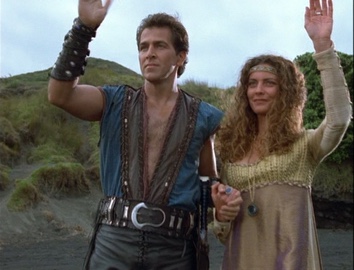
John D’Aquino as Ulysses; Rachel Blakely as Penelope
There’s another brief moment at the end of Ulysses which possibly ties in with Blind Faith: Gabrielle had been taught how to wave like a royal in Blind Faith, and we now see Ulysses stoically embracing his responsibilities as king, tilting his hand delicately just like Gabrielle did, along with his queen, Penelope (who, just as stoically, had to run the kingdom for the past twenty years). Like Xena, he’s fulfilling his destiny, not his desire.
Epilogue: Lost Mariner & A Comedy of Eros
Ulysses is the first of three water-related episodes, and of three which have Xena standing in for Athena (Ulysses, The Price, Lost Mariner), all of these sharing themes and influences. The next one, The Price, shares attributes with this episodes, which I’ll talk about in a later post, but I want to mention Lost Mariner here because Xena Warrior Podcast makes a very good point: they see Lost Mariner as almost a remake of Ulysses. The story has many of the same elements; they even point out that there’s almost a Greek “subtext” to the episode. Yes! Greek myth subtext exists throughout the series: sometimes it’s maintext, but just as often the elements are recombined and reused consistently to give the story of Xena the feeling of a genuine Greek myth, as well as a structure that otherwise would not hold together as well in the absence of a coherent chronology.They also suggest that Lost Mariner does a much better job in portraying the Odysseus we remember from of The Odyssey, so perhaps Lost Mariner is meant to fix the mistakes of Ulysses? No, I think we’re just seeing the other side of the coin:
You’ll recall I mentioned that Graves’ Greek Myths describes two sides to Odysseus’s character: (1) “Ulysses,” the gentler, polite, matriarchal version created by “Princess Nausicaa,” authoress of The Odyssey, and (2) “Odysseus,” the original patriarchal figure of myth. In Lost Mariner, we are now seeing the other one, Cecrops, who is modeled on “Odysseus.” He’s dangerous, worldly, crafty (he is now with the pirates), and also cursed by Poseidon to wander the seas. We see a number of elements from The Odyssey, such as Charybdis (which has no business being in the myth of Cecrops), but we also see elements from the Euripides play, The Cyclops: there are the pirates, and the comedic presence of Silenus, once again in the form of Gabrielle’s seasickness. There is also the blindness motif associated with the Cyclops: the answer to Cecrops’ dilemma was before him all the time, but he failed to see it. As Xena says: “I guess Poseidon gave it away when he said that Cecrops didn’t know where to look.” What saves Cecrops is the same thing that saved Hercules (in his first episode, The Wrong Path) and Xena (in both Unchained Heart and Sins of the Past) from the wrong path: the no-strings offer of friendship by someone who believes in them (in Cecrops’ case, offered by Hidsim’s sacrifice), and, more importantly, followed by the ability to express it (with his own sacrifice to save his crew).
Finally, season two ends with A Comedy of Eros, which may seem like an odd way to end the season, especially after these three episodes. There is necessity to it, since the season had been shortened to 22 episodes, but there is also a legitimate Greek context to view it in: Euripides’ The Cyclops is known as a “satyr” play, a short comedy intended to be viewed after a trilogy of tragedies on the same theme. Perhaps this story about how love is blind can be seen as a kind of satyr play to the three preceding episodes about Cyclops, searching, and blindness in all its forms, in Ulysses, The Price, and Lost Mariner)? Xena Warrior Podcast does mention the possibility, in a later podcast, that the tragic-trilogy-plus-satyr-play comedy pattern of ancient Greek drama may have influence this show’s pattern of drama followed by abrupt comedic tonal shifts. They are correct! Showrunner R.J. Stewart has said that the Greek plays were an influential source for him, and the internal evidence speaks for itself. The Greeks knew the wisdom of ending on a lighter note, and Rob has said he had considered ending the entire series that way.
This is the first of three posts—the next will cover Is There a Doctor in the House?