LADY OR THE TIGER?

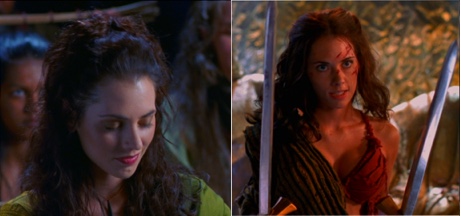
Last November, at the 2022 Salute to Xena in Los Angeles, Adrienne Wilkinson asked the crowd which version of her character, Xena’s daughter, they preferred? Was it Livia, Commander of the Roman Army & the Bitch of Rome? Nearly all stood up & cheered.

Or,

Was it Eve, her redeemed, pacifist counterpart, disciple of the prophet Eli? About half a dozen folks stood & cheered. I was one of them! Just 2 days prior, I had finished writing the 1st draft for this webcomic, but I was neither surprised nor disappointed.

I’d been in the fandom for decades, & knew that folks preferred Livia’s entertaining villainy, her cruel snark, explosive action scenes, not to mention, love scenes with the handsome god of war, Ares. And Eve? No romance, no action, no humor (except at her expense), & only the purest feelings of love for mankind. Surely her character was unsustainable? After all, Gabrielle began in a similar way: determined to follow the path of peace & love, until she was betrayed, taken advantage of, then followed Xena’s path as a warrior.

That’s usually how these arcs work out on tv shows. Peace & love is synonymous with naïveté; eventually, such a character learns that the only practical answer to violence is more violence, hopefully as little as possible. So I was very surprised that Eve stuck to her path.

She had one moment of weakness, in season 6, & a tongue-in-cheek moment later on, but the powers that be kept her true to path. I was really surprised by that, when it 1st aired. There was almost something transgressive about it. Some folks even thought producer Rob Tapert was trying to sneak a Christian message into the story (he was actually very concerned not to cross that line). I thought that was a very gutsy move, featuring a pacifist on a show that relied on action for its appeal.

Eventually, as I learned more about pacifism, I realized it’s not as strange as I 1st thought. I’ll talk more about that this week & next, but let’s get back to that half dozen of fans vs. 100s at the convention. If that ratio holds up in the fandom in general, then most folks reading this must wonder what appeals to us about Eve? My goal with this project is to fully communicate that appeal. But maybe I can give some idea of that now. There’s an old story about a man who has to choose between 2 doors. Behind one is a tiger. Behind another, is a lady. Choose the tiger, he’s dead. But choose the lady, & he must marry her. He asks his lover, a princess, who knows the answer, to tell him which door to pick. Whichever one she picks, she’ll lose him. So what does she tell him? We have to guess, & the answer tells us something about ourselves.

As I see it, Livia is the tiger, Eve the lady. Which do you choose? Pick the tiger, & the story is over quickly. Pick the lady, & you must endure seeing a character you love living another life. But, of course, that life is long, & full of interesting twists & turns, who knows what’s in store for you both? The lady offers a future; the tiger does not. But I would say you don’t have to choose, because in this case, the lady & the tiger are one & the same! There is only 1 character. Livia never goes away, & I believe Eve was never entirely absent either.

This is true on the show, as well. Ask Lucifer or Caligula if Livia’s spirit is gone for good. And ask Livia herself, who believed her own heart was a traitor. The best part of this project was writing for her character through the eyes of both, & the possibilities seem endless. Livia is much easier to write for, because she sticks to the script. There’s no limits to what she’ll do for you. She’ll kill anyone you want, betray anyone you like. But Eve doesn’t: she’ll befriend the opponents you write for her, mess with the allies you send to her aid, knock down any walls & break through any doors you set in her path. Try to contain her, & she’ll become bored & listless, until you see things her way. Trust me, it’s better to just let her figure things out herself. It’s awesome, in fact!

This week I’ll look at what shaped Livia/Eve’s creation, issues in writing for her character, challenges in expanding her character while matching the show’s arc. I’ll conclude with the music video that inspired me while writing for her.

Tiptoeing Through the Tulips

Sal the bookkeeper

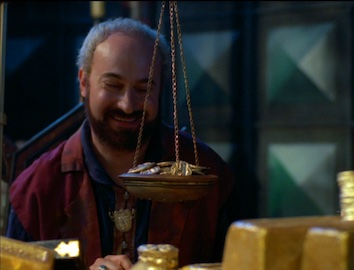
In season 3 of #HerculesTheLegendaryJourneys , we meet up with Salmoneus again. This time he’s king’s bookkeeper, & we can see his logbooks & abacus nearby. Decades later, he will need his own bookkeeper for his Known World Enterprises, a role that his daughter takes on for him. In “Men in Pink,” however, Sal can only dream of such riches.

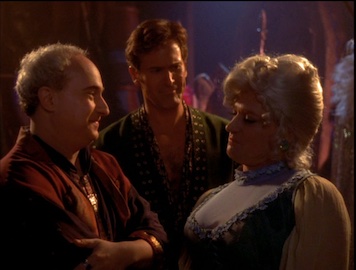
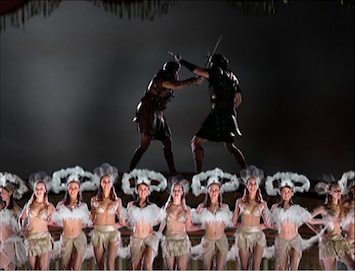
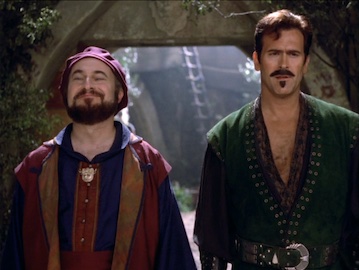
He’s quickly caught up in one of the most classic screwball comedies of all time, an homage to “Some Like It Hot,” with the ancient world’s equivalent of Marilyn Monroe. Both Sal & Autolycus dress up as women (Autolyca & Salmonella) & hide among a dance troupe to escape a false charge of murder. Sal has gone from avoiding war on #Xena by crowning a transgender model, to the world of cross-dressing men. It’s an old theatre tradition, of course, not to mention, common in military entertainment to this day.

In fact, this dates back to the time of Ancient Greece. They join the Twanky Tulips, a dance revue headed by the imperious Widow Twanky (played by Michael Hurst). The Widow Twanky is also an old theatre tradition, dating back to  the last days of the Commedia del Arte in Britain. She was originally in a pantomime production of the Arabian Nights, a series of Middle Eastern folk tales. The name Twanky is based on a Chinese slang word for tea past its prime.

The part was always played by a man in women’s clothes, & has been played by such actors as Ian McKellan. Michael starred in a production of the Arabian Nights, & created his version of the role, & for Hercules, turned her into a formidable lady who specialized in dance. In this ep, she even uses dance moves to fight with! This ep makes good use of the pantomime tradition of cross-dressing players, with all the leads doing so. It’s the only time we see actor Robert Trebor without his signature Salmoneus facial hair, even after he returns to his old outfit.

Salmonella in pink

This ep ends with the Widow revealing that she knew all along the 2 fellas were in disguise, & fully approved of them doing so. After all, a man can learn a lot by spending some time in a woman’s shoes! The Widow returns for another ep, Greece is Burning, based on the 1990

Sal, Autolycus & the Widow Twanky

documentary Paris Is Burning, about the  NY drag scene. I did not use the Widow Twanky in my upcoming story, but was greatly inspired by her to draw upon the pantomime tradition & the Commedia del’Arte, which finds its roots in the ancient world, so I depict what I believe are its earliest known practitioners. In particular, the idea of blending dancing & fighting styles is especially fascinating to me, & important to this project. Michael Hurst is a classically trained actor familiar with the pantomime & Ancient Greek plays, & is another reason why Renaissance Pictures is so well-named. Tomorrow, let’s talk about Eve!

Save the best for last

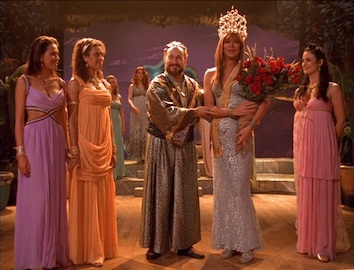
Salmoneus crowns Miss Artiphys Miss Known World

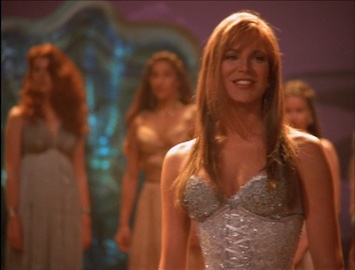
Going out with a song on #PrideMonth , Salmoneus awards Miss Artiphys the title of Miss Known World, played by transgender actress Karen Dior (this  was Sal’s last #Xena ep, & the only ep in which he sings). In real life, Karen was also an AIDS activist with a PhD in philosophy of religion, & an ordained minister, so it was only natural she would inspire a character in my story, a multi-faith Elijian with the Council of Elders.

Karen Dior

Aquarius and Various

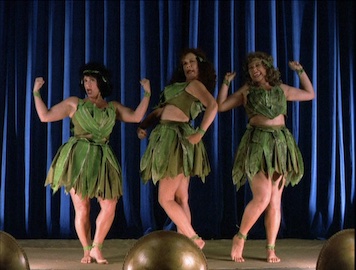
Gabrielle’s “A Message of Peacegets a little jiggle from 3 wood nymphs

Something I had to keep in mind about canon for my project is that I had 3 different kinds to juggle. Although my story is a #Xena episode, it actually draws upon 3 of the “RenPic Cinematic Universe” shows: Xena, #HerculesTheLegendaryJourneys , & #YoungHercules.

In my view, the 3 comprise one complete story, but they approach it in 3 different ways. In a Xena ep, Xena is the source: she caused the problem, she solves it, & along the way, she’s the source of all important info about it. Even when she has no way of knowing the info,  she delivers it to us. The result is a highly unified story, which makes it the most sophisticated of the 3 shows. It’s like the “Oedipus Rex” of Greek tragedies: the perfect illustration of a hero that encapsulates all the story’s choices & destinies in one.

Even when Xena isn’t present, she’s the subject of the ep. Hercules is very different: the hero is more of a mediator, a peacemaker, & we see more of the world beyond him, because he’s just one aspect of it. When he’s not in an ep, life goes on.

In a way, he’s actually a good model for Eve the Messenger, & in fact, next week I’ll talk about how Eve’s roots may actually be on Hercules. Young Hercules is more limited in scope. It’s set in ancient Greece’s equivalent of a high school, a military academy, complete with “malt shop,” actually, an unusually cheery, sunlit tavern nearby, frequented by the younger crowd. Most of the stories focus on learning how to take on responsibility, & retaining one’s values as they face a morally complex world.

One of the leads has to take over his father’s kingdom at an early age, & it’s clearly not an envious task to wear the crown. There’s virtually no romance at all. There’s a female student, an Amazon, but she’s just one of the guys. Is a serious look at becoming an adult.

Despite that, Young Hercules has a lot of fun with concepts that appear in Xena & Hercules, & I found it a good source of how RenPic did world building in their version of Ancient Greece. I also found it inspiring when trying to imagine how Livia spent her younger years, since this would’ve been similar to her environment, I believe. Not to mention, the Elijian youth movement, who would be similar in spirit to YH’s cast.

Later in Hercules, they revisit the academy of his youth, to find it’s become a very different place, expanded in scope & much more ruthless & corrupt. This is more how I imagine Livia’s upbringing, & given the timing of its appearance on Hercules, it would’ve coincided with the Xena staff’s preplanning for her arc. So all 3 shows were helpful to me in expanding Eve/Livia’s character & world in a way that feels authentic to me.

Why not just stick with Xena’s world? Because of the highly centralized nature of its stories, there isn’t much breathing room for a third main character, & it’s hard to conceive how that would work. As it is, I think the writers pushed it as far as they could go with her; any further, & the show could’ve felt unbalanced. I’ll talk more next week about the challenges of her character, & I’m impressed they got as far as they did.

I’ll talk more about canon as I go through the project, but one more word for now. The Rosetta Stone of Xena canon, imo, is a show that ran concurrently during its 1st season: American Gothic. It’s completely unrelated, but because it ran 1 season, the gothic concepts it introduced were picked up by Xena. The most important one, for my purposes, is the Rosemary’s Baby-inspired arc. The Child of Destiny motif is big in Xena, throughout its run, & finds it biggest expression in Eve herself. This was something I kept in mind for this story:

She’s not merely a personality, but has real thematic momentum behind her, & that impacted how I expanded on her backstory. I’ll close with another video that inspired the look of this project. There’s a lot of dance-related videos I looked at, & this one helps connect several storylines.

The opening dance sequence in the musical Hair shows tai-chi-inspired dance in NY’s Central Park, as witnessed by a recruit bound for Vietnam. Here it illustrates their freedom and uninhibitedness, & it inspired how I portrayed the Elijian youth,  but strangely enough, it also inspired how I imagined teen Livia danced. Her military discipline would’ve drawn on the same movements, in a very different context. To me this illustrates the idea of synchronicity: how lives & events seemingly headed for tragic collision can suddenly find themselves aligned, as if by the planets & stars themselves.

Comedy Is Hard

Sophocles’ Women of Trachis: The Musical

One of the things that gets tricky about canon in #Xena are the comedy episodes. They seem to challenge the idea that there’s any consistency. Should we consider them part of #Xena’s actual story? I’ve heard some argue that anything that couldn’t literally be  in Gabrielle’s scrolls shouldn’t be canon. Sorry, Soul Possession! Then there’s one of my favorite eps, You Are There, that couldn’t possibly exist anywhere, seemingly. But I consider these all canon. There was a translation of Sophocles’s only surviving comedy,

“The Trackers”, a story about Apollo fighting with the satyrs over Hermes’ new invention, the lyre. Since only half the play survived, Harrison filled in the rest about the team that discovers the fragment, & sets free the characters in the story. Chaos ensues!

There’s a number of reasons why I believe this was a source for #Xena (Lyre, Lyre, Hearts on Fire, etc.), but I’m also interested in the “uber” quality of this translation. It shows how the past is present, & the classic themes are eternal. More to the point, it tells me that the show’s canon isn’t just about plot or character, but it’s about how it’s all presented: the aesthetic, or style, is as important as the story itself. It also tells me that we can’t really understand the past without a good sense of humor to put it in perspective. It’s good to have a healthy appreciation for the ridiculous (a life lesson that took me a while to learn).

So, with that in mind, what about You Are There? Perhaps that was also a translation, using a fragment of Gabrielle’s scroll, & the only way to knit those scenes together was comedically? Nothing really happens that isn’t true to character, after all. Not even Eve’s scenes, which I don’t think would actually have played like that, but I can definitely picture her doing things like that: there was some real  overturning-the-tables-in-the-temple energy there! The scene implying the Elijians are repressed sexually, indulging in disguised role-play, is something that may be embellished, based on perceptions about the cult, but I lay the groundwork for that in my story, with one particular sect that practices celibacy while waiting for Eli’s return.

The idea of a musical ep finds fertile ground in the Greek plays, because they were the original musicals in Western theatre tradition. Opera was invented in the Renaissance as a way of recreating how they might have looked. It’s fascinating that #Xena almost had a 3rd musical, featuring Sappho: that unproduced script also uses celibacy as a plot point. It went through many incarnations (at one point, spawning Lyre, Lyre), but never happened. 

Apparently that musical never left Rob Tapert’s mind. In 2017, he produced Pleasuredome in New Zealand, starring Lucy, directed by Michael Hurst, which used that idea, set to 80s music this time (the original script used 70s disco, I believe).

It just goes to show if you hang in there, things can eventually fall into place! I’ll finish up my thoughts on canon tomorrow, then move on to at look at how I view Eve’s character, possible origins & development.

Appropriate or Appropriation?

Joxer, the Hanged Man of the Tarot, can’t shake his image, in The Play’s the Thing

An important part of canon in Xena, Hercules, & Young Hercules is the use of Greek myth, cinema, & world religions as part of its aesthetic structure. In a show that uses a lot of references, you can imagine how elaborate it gets as they intertwine over seasons.

These days, there’s an additional concern, that of cultural appropriation. Using references to religions & cultures in the name of entertainment are considered insensitive by some, depending on how they’re used. The audience is global, these days.

The nice thing about Xena et al is that they were designed for global audiences already, so imo past the test a great deal of the time. Not everyone agrees, but I think there’s some misinterpretation at work in those cases. Some things I’ve heard criticized recently:

Depicting Indians as primitive for the practice of suttee in Between the Lines (i.e., burning the surviving widow with the deceased husband, as his “property”). The alleged stereotypes in “The Way” commonly found in Hollywood films about the Arabian Nights.

& I’ve heard it said that the Horde in The Price is a racist depiction of aboriginal people of color. I see these in a different context. “The Way” looks to me like an homage to Bollywood, & that’s how many Indian viewers interpreted it.

I’m a big Bollywood fan, & that’s how it looks to me as well. Those films often play with the depictions of the Indian gods, just as the West gets creative with its own depiction of Christianity, & the dividing line between homage & pure entertainment is often blurry.

The practice of suttee, sacrificing the widow, was indeed an ancient practice in India, but it was also an ancient practice among the Vikings and the Greeks. Euripides even included it in one of his plays about the Trojan War. So why does Xena single out India? It doesn’t!

In season 2’s Blind Faith, we see Gabrielle wedded to a dead man (Greek), & nearly burnt with her deceased husband, 2 full seasons before “Between the Lines.” Re: the Horde in The Price. Its racial makeup is actually no different than the Athenian soldiers who fight them.

But what most interests me is that we eventually learn that the Horde lives underground, & in caves. This, along with suttee, I believe is a cinematic reference to the film The 13th Warrior. Based on a true story, but fictionalized by Michael Crichton, this film is a known source for some of the writers of Xena & Hercules. It’s the story of a Persian diplomat who travels to the land of the Vikings (the true part) & encounters a prehistoric race of matriarchal warriors that survived into the modern era (the fiction part).

It’s a fun movie, & there’s numerous episodes that play on its plot points in Xena & Hercules. The prehistoric tribe lives underground, in caves, like the Horde, & are unintelligible. Actually, the Vikings are unintelligible to the diplomat, who learns their language simply by watching them. This connection between primordial humans & ability to speak occurs throughout both series. Its last appearance, I believe, is in season 6’s The Abyss. Why do they use The 13th Warrior in this way? That’s a matter of interpretation, & you don’t need to ponder the connection in any way, unless you’re wondering why all these things are popping up. If you assume they’re problematic associations, you may miss the larger pattern. Myself, I think it has to do with Rob Tapert’s wish to illustrate how religion develops & spreads. This is the reason given on one of the dvds, & it makes sense to me. Religion was extremely fluid in the ancient world, & not governed by national boundaries (which didn’t really exist as we know them). This is what fascinates me about Eve’s story, as it takes this idea of the growth of religion & extends it into an era that’s more familiar to us in the West: the time After Christ (A.D.). You can probably guess this would also be extremely problematic to explore, & that’s a major concern of mine as well, for this project.

Hinduism also exists in our era, but it’s unavoidable for #Xena: she is openly & conceptually tied to Hinduism, & the show stays true to that to the end, rather than just borrow the images. I’ll explore the issues of depicting Eve’s religion in the next 2 wks.

Not Greek To Me

A Greek Theatre in The Play’s the Thing

Writing according to canon for a show like Xena is a toughie, because it seems so chaotic. I’ve spent a lot of time compiling what I think makes up the show’s aesthetic canon, based on my watching the show, reading interviews, and researching the source materials.

A fair amount is guesswork on my part, but it was important to me that I have a grasp of things that couldn’t be figured out just from observing the show. Why did they repeat certain types of motifs throughout the series? 

Why did they avoid using quite obvious stories from Classical Greek lit that would seem to fit the show like a glove? Such as the Trojan War? The depiction of Troy in #Xena & Herc are very non-intuitive, & seem totally unrelated. Why does the show look the way it does?

There’s no Greek architecture, for example. Every other kind, but instead of Greece, they depict a kind of gothic realm. Some say it’s a cost-cutting measure, but that doesn’t make sense. Greek buildings are highly modular. You can save a lot of money reusing those columns.

Ridley Scott did, in Gladiator, when he created the sets for the imperial palace & the Roman Senate with just a few pillars & curtains, moved around. In fact, RenPic did save a lot of money, by shooting a lot of scenes in forests & parks.

But they seem to have spent a lot of time creating an alternate Greece. So it was definitely an aesthetic choice to build things in such a distinctive & unique way. Others say they just didn’t know any better, but clearly, they did.

RenPic went on to make Spartacus, full of period detail. As I present this project, I’ll explain why I made the choices I did, based on what I believe to be the aesthetic logic of the show.

The Canon’s the Thing

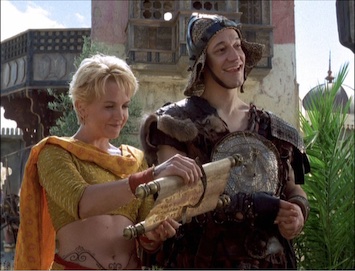
Gabrielle & Joxer in The Play’s the Thing

As I mentioned, I am attempting to make this #Xena webcomic as close to canon as possible. But what exactly does that mean? Is this a show that has that kind of organized approach, and even if it does, is it still applicable, 20 years later?

When I first started watching #Xena, I heard that the show had no story bible, that there was no real canon to speak of, & there were an abundance of quotes indicating that the writers made it up as they went. The show’s abrupt tonal shifts seemed to support this.

This was not an issue for most, for a number of reasons. This was an appealing action/adventure show, introducing a new iconic female hero, great characters, & a ground-breaking show in its depiction of a same-sex relationship.

Who cares about canon, when you’ve got all that? I agree! I myself thought the show was a mess, until the 6th season. “Path of Vengeance” (Eve’s last ep) was the 1st indication to me that the show was much more organized than I guessed. The series finale sealed it for me.

They obviously knew what they were doing. I needed to rewatch it to figure it out! I haven’t stopped, since 2001. Since then, I’ve heard about the need for a #Xena sequel to “fix” the series ending. Rob has recently said he doesn’t think anything needs fixing, & I agree.

But I agree with Lucy that it needs reviving. How do you do that without “fixing” the finale? As I see it: accept that everything on the show is canon. It all happened, & it all counts. Same for #HerculesTheLegendaryJourneys, and #YoungHercules , too.

Will I succeed at this? I’m not sure. For an outsider, it’s sort of like resurrecting a dead language. You give it your best shot, by using everything you have, & incorporating everything you know. It’ll be fun to try, & it’s an extension of the fan experience, as I see it.

It’s all part of the #Xena Cinematic Universe, so embrace it all with a full heart! So lets talk this week about what canon means for this show, and how to build on it, and retain its magic. There’s no magic formulas other than accepting the show for what it is.

Salmoneus

Salmoneus & Autolycus

This is Salmoneus’s last scene on Hercules the Legendary Journeys: “ Genies & Grecians & Geeks, Oh My!” ( Note the Wizard of Oz reference!). Sal was peddling art to a sultan. He wears a beret, now that he’s in the art world. He get strapped by a genie in a magic lamp with Autolycus the thief. Sal makes a wish that harkens back to one of his earlier eps, when he goes into the self-actualization business, in The Outcast (co-starring Lucy Lawless). There, he just wants to be “the best Sal I can be”, & make money hand over fist helping people.

 Here, he wishes for self-improvement, which conjures up 3 versions of himself. In the final scene, he & Autolycus manage to escape, & as they leave, Sal says to. Autolycus: “This could be the start of a beautiful friendship!” They each consider the implications of that, grimace, then slip away in opposite directions. This aired Oct 1998, & the final Herc ep ever aired a year later. During that time, it was joked on the show that Sal was arrested for tax fraud, & that gave me the idea of having Sal return as the object of Livia’s contempt, 21 years later. Sal’s final quote is a quote from “ Casablanca”, so it’s fitting that he’s exiled to Cyprus, which on Hercules, is a stand in for both Paris (given the Aphrodite connection & the use of similar letters), & the West African city of Casablanca. 

It appeared on only one ep, “We’ll Always Have Cyprus,” (another Casablanca  homage!) in which the city looks very much like a Moroccan milieu. To me, it’s a nice closure for the character. 

In my alt history of this show, Sal’s next appearance is over a year after his last one, the first of a trilogy where he reconnects with a character he previously met, & later becomes his wife.

Next week, I’ll discuss how I view canon on #Xena & #HerculesTheLegendaryJourneys

Protean Challenge

Proteus & Hercules

A footnote to yesterday’s post about Proteus: this god appeared on Hercules The Legendary Journeys. It’s an unusual episode because Herc admits he used to be kind of a jerk to him. There are elements of the myth  in this ep: Herc plays the role of Menelaus, wrestling with Proteus while he changes shapes. The story of Protean Challenge also concerns a father & daughter, with Iolaus standing in for Menelaus for that portion of the story. More specific to the play, the ep ends with Proteus changing into a dove. 

Is that an intentional reference to the only surviving line from Aeschylus’s lost play? The writer of this ep, Brian Herskowitz, went on to write another Herc ep, A Star Shall Guide Them, which ends with a nativity scene hinting at the birth of Christ. 

Interestingly, the feeling they all get from this baby of destiny is peace, the message Eli will deliver. This is one of numerous coy suggestions that the show is set in New Testament times, but none of them actually line up chronologically. 

For example, 8 months later, #Xena’s Christmas ep, A Solstice Carol possibly shows us Mary & Joseph looking for an inn. This teasing of the  arrival of the one God continues until the appearance of Eli & Eve.

#HerculesTheLegendaryJourneys