Gabrielle and Xena ride away on their faithful steed, Argo II
This is another drawing from the #Xena virtual Season ep, The Laurel Tree. Gab leaps onto Argo II’s back as Xena rides away. I like this one as well, as it gives you an idea of motion despite them just sitting on a horse, due to the progression in their poses.
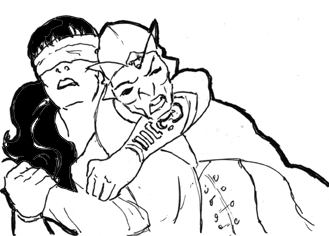
More Virtual Season drawings from The Laurel Tree, this time #Xena wrestling with Alti. This has a rotoscoped Ralph Bakshi cartoon look. Tho Xena is an action show, it’s a challenge capturing that in comic book form. Emotion is key, & I tried to capture that at least.
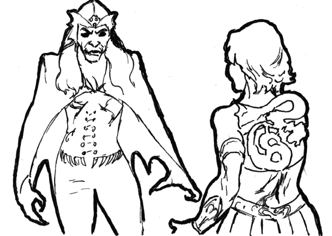
Another Laurel Tree sketch for the #Xena Virtual Season. Gabrielle confronts Alti. I was pleased to have the chance to draw Alti. I think I designed her look, but am not sure. She definitely looks like a Little Nemo character here. Gab’s costume was designed by the staff, the AFIN tattoo is covered by tattoo-shaped armor.
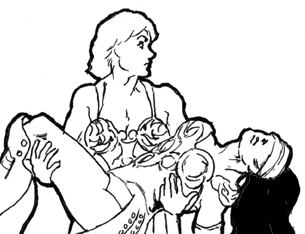
This is one of my favorite drawings, also from the #Xena Warrior Princess virtual season episode, The Laurel Tree. Xena has been injured & blinded (blindness is a common motif on the show), & Gabrielle is valiantly carrying her to safety. Gab is often the rescuee, so I loved the idea of turning that around.
This is the first drawing I contributed to a #Xena virtual season in late 2001 I believe. I joined it halfway into its “7th season”. The name of this ep was “The Laurel Tree,” a beautiful elegiac tale. This particular vs had a number of eps like that, which suits my mood.
It was influenced by the classic film To Kill a Mockingbird. You’ll notice Gab’s outfit is different than the tv show. Keep in mind this is after A Friend in Need, so she still has her tattoo, & she’s more armored, due to having wielded the chakram.
I didn’t design the costume. The vs had an editorial team that designed new costumes, etc for the main characters, as needed, then supplied the models to guest artists (like me). I think I made her hair slightly longer to show passage of time from AFIN.
I’m currently preparing the drawings for my project, but in the meantime, I wanted to show examples of the last time I attempted a comic book approach to #Xena, when I worked on one of the virtual seasons which popped up just after #Xena ended, in 2001.
My work was inconsistent (putting it charitably) due to my wrestling with artist’s block. Years later, I overcame it, a process I’ll talk about later, but I’ve always found #Xena friendly territory, regardless. Like a lot of fans, it’s always been my safe space.
Over the next week or so, I’ll talk about that experience, & what I enjoyed about the process, which was very different than working on my own. I’ll spare you my worst efforts, though; not every drawing needs to be immortalized!
Eve & Aphrodite chatting at the end of The God You Know
I want to go back to this fascinating moment in season 6 of #Xena, at the end of “ The God You Know.” Eve & Dite are sharing a friendly moment despite Eve being the harbinger of the end of the many gods. Of course, Aphrodite is not actually a god at this point:
Caligula had drained her of her immortality. But Eve herself was never a champion against them, just the object of their paranoia, & the catalyst for their self-inflicted downfall at #Xena’s hands.
I mentioned in an earlier blog post that Dite has a future despite the coming of the one god of Eli. I felt strongly about this, & set this up this concept in my story, but is there any actual truth to this? Did the show’s powers-that-be feel the same way? After all, the original plan for the Twilight of the Gods storyline involved killing off Dite, with only Ares surviving. It makes sense, after all: with Eve & Eli’s God of Love arriving on the scene, having another love god(dess) around seems redundant. Thank goodness Rob & R.J. overruled this when they returned from managing their spinoffs to rectify this.
Why did they do this? As explained in You Are There, set right after Eve & Dite’s scene, we’re told it’s necessary to have both Dite & Ares to achieve balance in the world. So the God of Love is therefore not sufficient to balance out Ares. Why not? Because I suspect the God of Love represents a different kind of love, a more selfless & non-transactional kind of love. Dite’s love is more incarnate, & in a way, she kind of balances out the selflessness that the God of Love inspires by adding a necessary amount of desire that physicality demands
if the species is to function properly. This desire could range from pure carnal lust all the way to the energizing feeling of being in a crowd, & this can actually help supplement the spiritual love that Eli preached about. Without it, we might feel an intellectual compassion for each other, but feel irritated & even repulsed by other’s’ unnecessary proximity.
Is there anything in the show itself to indicate that this is how the writers saw it, though? I believe there is. In You Are There, we see a world without physical love, now that Dite is mortal.
People quickly lose their tempers with each other, & visit brothels to pay for what they can’t naturally feel. But the Elijians should be immune from this, since their god of love is doing just fine, right?
Wrong!
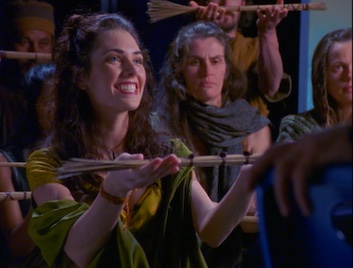
Eve & her prayer circle are fully concentrating on their meditation, but clearly can’t hold onto their feelings of love. Eve quickly loses her temper with a journalist, & her followers grimly crowd around him. They haven’t forgotten Eli’s teachings, they just aren’t feeling it!
Eve & the Elijians make a peace offering
After Dite gets her powers back, however, it’s a different story. Eve’s prayer circle appear as friendly guests on his tabloid show, & offer a very physical & downright carnal peace offering. They’re a bit off-balance, in other words, as their commitment to Eli’s spiritual love is suddenly flooded with an unexpected rush of physical desire.
I’m guessing they all felt a bit silly afterwards about their lack of self-control, but given how everyone else was knocked off-kilter without Dite’s moderating influence, the Elijians handled themselves pretty well, I think. I suspect the future of the Elijians involves a lot of negotiating between the powers of the GOL & Dite, with varying degrees of success.
There is so much more to talk about when it comes to Elijian beliefs & how they’re intertwined with the show, but I’ll just make 2 more points. First, my belief is that had #Xena Warrior Princess continued on several more seasons, we would have seen her story move more into a gothic sensibility, something more resembling the roots of the Evil Dead series. We kind of see something like this in the 6th & final season of #HerculesTheLegendaryJourneys. The most recent RenPic series to date, Ash Vs the Evil Dead, is a bit like how I imagine it, except with more elaborate cosmology after Paradise Lost, & other sources. The Olympians would still play a role, but would look different. I think the God of Love causes a paradigm shift in human affairs, & this reverberates with them, because as people change, so do gods.
Exactly how do I imagine that? That’s a story for a different time, but I see a colorful future for a revival, if it happens. A more colorful Olympus, & as a Valley Mom rather than a Valley Girl, I’d love to see Alexandra Tydings return as a wiser Queen Aphrodite!
Finally, I’d like to talk about the Elijians’ pacifism. I’m fairly certain that doesn’t sound appealing to anybody, but I disagree. A lot of the action on #Xena is nonviolent in nature. Most of the Indiana Jones movies are nonviolent. Violence is only a small part of action, & suspense. I’ll talk more about this next week, but my research into the roots of violence, & the treatment for it, was key to my understanding of Livia’s nature, her backstory, & her recovery. This whole project is like an illustration of her journey.
To end this week’s topic, I’ll post a music video that to me represents the ideals of the Elijian movement. I needed something I could listen to everyday that invoked their community, its simplicity & its majesty. It’s an orchestral piece that comes from the 1985 movie Witness, starring Harrison Ford as a big city detective who’s protecting an Amish eyewitness to a murder. He goes to their village, & doesn’t seem to fit in, nor does he seem welcome. One day, a couple marries, & the community gathers to build them a barn, in just a few hours, by working together. Ford is asked to join in, & since he’s a carpenter in real life, he does rather well. As the day progresses, he bonds with the others, & starts to realize their simple way of life makes a lot of sense after all.
Maurice Jarre wrote the score, with synthesizer for the scene, but he also wrote a version for full orchestra, which I think sounds much more like how #Xena composer Joseph LoDuca would arrange it. Australian director Peter Weir used Pachelbel’s Canon in D as the temp track for Jarre’s score.
First, I’ll post the link to the scene itself, the most famous one from the film, if you want to see it in context, with a light synthesizer arrangement. Then I’ll post the orchestral version:
And now the full orchestral version used for this project (I never get tired of listening to it!):
I had a very long thread for tonight about my thoughts on St. Paul & how he relates to Eve. He’s a fascinating figure who was viewed very differently in his time than he is nowadays by his own church. It’s problematic, though, & difficult to discuss in social media bites.
So I’ll just briefly discuss his impact on the show, & my story. Paul changed the world with his message of unconditional love, & used his own forgiveness by Christ as proof of it. He was a formidable intellect who could argue with the best minds of his day.
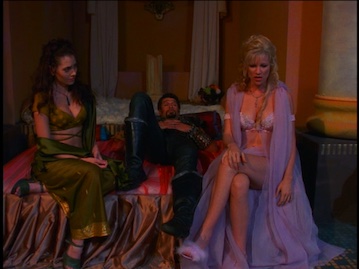
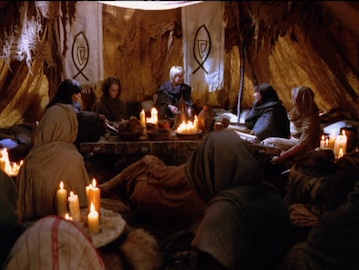
In Greece, they called him The Messenger, because they believed he was Hermes, the messenger of the gods. He enjoyed Greek theatre, & even quoted Euripides in his letters. Only half of his letters were actually written by him, & there were alterations in later years to conform with less tolerant views, so it’s hard to pin down Paul’s views exactly, but today’s scholars regard him as much more progressive than history depicts. Women were church leaders in his day: they hosted his meetings (much like the pic above) & funded them, since they also ran the households & kept the books.
When he baptized new converts, he would say: “For there is no longer Jew nor Greek, slave nor free, male nor female, for you are all one in Christ Jesus.” To the extent that he counseled obedience to Roman traditions, which he despised, it’s only because he believed he was the last generation. Had he known we’d be reading his words, he’d have written an official document for public consumption, & no doubt would be known as even more radical than he was.
Paul was a disruptive force when he came to town; like Ghandi, he was a sweet old man who could undermine the authority of the establishment, & he spent a lot of time in jail as a result.
His career began after his conversion, & after he recovered from the blindness of seeing Christ. He traveled to Cyprus, where he met a sorcerer named Elymas. Facing off against him, Paul blinded him, & won the local leader to his side. It was at that moment that Saul took on the name of Paul, from Latin, meaning “Small”, an ironic term, given his stature in history. I combined this story with the myth of Proteus to illustrate Eve’s taking on of the public role of the Messenger of Eli. Tomorrow I’ll look at how I think the Elijians can both preserve & expand #Xena’s story in a revival, & how pacifism plays a role in an action tv show.
There’s no one size-fits-all influence on #Xena, & a lot of them overlap, but The Last Temptation of Christ is one of the big ones, imo. It’s there from the very beginning of Xena’s adventure, & its presence is felt to the end. This should come as no surprise:
We know from the dvd commentary that religious history played a big role in shaping #Xena’s story, so it makes sense that landmark films like Last Temptation would be a factor. According to George Strayton, who helped craft season 5’s arc, & wrote Seeds of Faith, Rob Tapert gave him a copy of the book to incorporate into the story. It’s safe to assume R.J. Stewart got a copy at the beginning, as well, & it came in handy in season 6, no doubt. We see it in specific ways, but also as a general influence.
The whole idea of what life would be like for #Xena had she chosen a different path is there from season 1 to season 6’s When Fates Collide. The repeated motif of her crucifixion fits the story’s pattern, as well. I loved the movie, & I’ve read the book several times. Its author, Nikos Kazantzakis, also wrote Zorba the Greek (the film starred Anthony Quinn, who also played Zeus in Tapert’s original 5 Hercules movies. Last Temptation, book & movie, has attracted a lot of controversy, but the author didn’t intend that. He wrote it as a devout Christian wishing to understand the choices Christ made in his time on earth. It’s a meditation on how to regard God’s creation, the world we live in, & the transcendent divine, which lies beyond it.
He depicts Christ as being torn between the two, trying to envision his destiny in Heaven while blinded by the beauty & ugliness this world. Growing up, he feels the shame & sparseness of not knowing his true purpose, & once he glimpses it, finds the world all too beautiful, soon to be left behind.
To me, #Xena is about the struggle to realize your true self, & that’s the theme of this book. It’s a big part of Eve’s story, for me, since she has a very similar quandary, being torn between 2 very different roles & personalities. One of my favorite moments in book & movie is after Christ is baptized, & the fiery John the Baptist, who preaches the wrath of God, exhorts him to be a cleansing fire in the world. “But isn’t love enough?” Christ asks. “No,” John replies. “The tree is rotten. Take the ax & strike!” Christ, who represents a new way, can’t.
He says “If I were fire, I would burn; if I were a woodcutter, I would strike. But I’m a heart. I love!” We can hear this in #Xena, when Callisto visits Eli in Seeds of Faith, when he has his Gethsemane moment of doubt. She tells him: “The order of the gods must fall and you, Eli, are the hammer.” The most notorious section of the book is the final 3 chapters, when Christ, on the cross, considers the devil’s suggestion that he doesn’t have to go through with crucifixion to the end. It’s also significant for #Xena as well.
Just before this scene, Simon picks up the cross when Christ stumbles, & carries it for him. Simon is a tavern owner, & is known as the Cyrene. In #Xena’s pilot ep, Xena faces judgment when she visits her mother, Cyrene, a tavern owner. At this same moment in the book, as Simon carries his cross, Christ sees a vision of his mother, filled with lifelong anguish for her son’s inability to find his place, & addresses her: “All my life I toiled to turn the Curse into a blessing. I’ve done it, & we are friends now. Farewell, Mother!” This is analogous to #Xena’s relationship to her mother in the pilot, willing to be pelted with rocks if that would satisfy her judgment against her. Another key moment is just after this, when Christ utters the famous phrase: “My God, my God, why have you forsaken me?”
The book uses the Aramaic translation, & only the 1st several words, before the chapter ends, & Christ’s alternate life as a mortal begins. He says “Eli…Eli…!”
Originally, the character of Eli was supposed to be named Issa, after a pop theory that Christ went to India where he was known by that name. Rob Tapert realized that was too on the nose, & would create controversy, so he changed the name to Eli, & I’m certain it’s because of this passage. Right afterwards, Christ steps down from the cross, after being greeted by a kindly angel. In reality, he is Lucifer, & the only sign that something is off is that his wings are the color of green grass. During all 3 chapters of Christ’s alt-dream, there is this eerie presence of green. Sort of like The Matrix, how it seems to signify a deceptive reality.
(I wouldn’t be surprise if The Matrix drew this concept from the same book). For the purposes of my story, there’s a very interesting passage having to do with St. Paul. Mary Magdalene marries Jesus, & confronts Saul, the Pharisee. Because there are no Christians in this alt-reality, Saul follows his bloodthirsty ambitions, until he becomes as ruthless as Livia! He’s on a mission to kill Jesus, but Mary tells him: “I was just thinking what miracles you would perform if God suddenly flashed within you & you saw the truth! To conquer the world, my beloved needs disciples like you—not fishermen, peddlers & shepherds, but flames like yourself, Saul!” Saul says: “With love? I too want to conquer the world! In the meantime, I find relief by killing others!” Later, as an older man, Jesus confronts Saul, now self-named Paul, preaching the word of the crucified Christ. Jesus calls him a liar, but Paul laughs in his face: ‘I shall become your apostle whether you like it or not!” This version of Paul is more like John the Baptist: Love is a cleansing fire, filled with judgment.
Jesus realizes the unique nature of his message, & how he was not merely an empty vessel for God’s word, but had specifically shaped it with his gentle heart. It was to be his unique gift to the world, now denied its influence. It’s clear in the context of #Xena that Livia’s conversion by Eli was very similar to Paul’s conversion on the road to Damascus. But seeing this specific depiction of Paul, we see that Livia is very much an alternate reality version of him. As Eli’s word is spread, we see the presence of the color green.
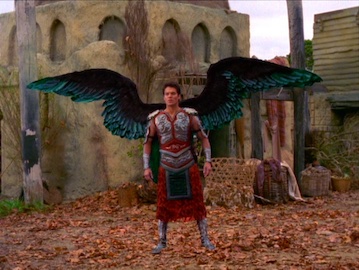
And just as Lucifer had green wings in Last Temptation, so does he on #Xena. So does Michael & Raphael! Are they deceivers as well? Hmm, maybe there’s just more to them than we can see, but I feel the green color of the Elijians signifies, if nothing else, that we are seeing an alternate version of Christianity, one tailor-made to the themes of #Xena. Tomorrow, I’ll talk more about the real Paul, also a very interesting fellow.