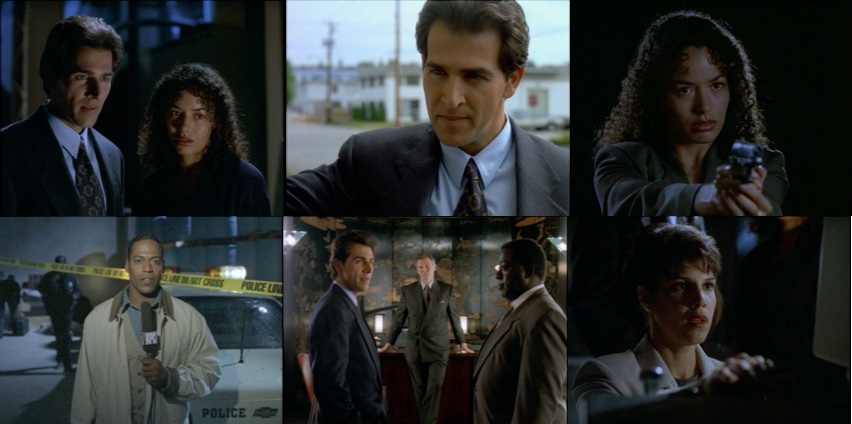
Top row: John D’Aquino & Galyn Görg; John D’Aquino as Agent Raymond Geary; Galen Görg as Lt. Leora Maxwell. Bottom row: Cylk Mozart as Spencer Perry; D’Aquino, Andrew Robinson as Solomon Box, Blu Manama as Chief Grant; Jo Bates as Kathy Rhodes
I’ve mentioned that there were a number of future Xena Warrior Princess guest stars on M.A.N.T.I.S., but it was pointed out to me that I missed a few: John D’Aquino and Galen Görg. As coincidence would have it, they played the characters Helen (of Troy) and Ulysses; in other words, they were the stars of Homer’s Iliad and Odyssey! Also coincidentally, each episode of theirs would involve a potential significant other: Gabrielle’s childhood betrothed, Perdicas, who goes to Troy to prove his manhood and rescue Helen, in Beware of Greeks Bearing Gifts, and Ulysses’ and Xena’s mutual attraction getting in Gabrielle’s way in Ulysses.
In the 8th episode of M.A.N.T.I.S., To Prey in Darkness, D’Aquino is a smooth talking federal agent who muscles his way into local law enforcement to work his real agenda: discover the identity of M.A.N.T.I.S., and confiscate his technology for sale to the highest bidder. He brings a disturbing presence to the show, using his interrogation techniques to provoke revealing responses from Dr. Hawkins and others. He’s full of all sorts of power moves, invading peoples’ space, manipulating them, and even moving Dr. Hawkins’ wheelchair out of his reach. Not a nice guy!
Galen Görg not only played Helen on Xena, but also played Anuket, an Egyptian princess who ends slavery in Mummy Dearest, on Hercules the Legendary Journeys.
This episode had some of the elements of the pilot, bringing in more realism (compared to the later episodes, at least), and more black actors. The role that Bobby Hosea played in the pilot is recalled here by Cylk Cozart, an ambitious street reporter for local news, and Chief Grant is played by Blu Mankuma. Both he and Jo Bates have a Hercules connection as well: they both appeared in Andromeda, starring Kevin Sorbo. That show also had a problem with the creator leaving due to network pressure, to appease Kevin Sorbo who didn’t like the direction of the show (the original concept was increasingly esoteric).
There didn’t seem to be a lot of crossover from M.A.N.T.I.S. to Xena, but writer assistant R.S. Mellette also made the transition. On Xena he wrote The Xena Scrolls, and it seems to me his specialty was helping to create the lore behind the early seasons, and may have played that same role on M.A.N.T.I.S., before it became more fantasy oriented. Rob Tapert and Sam Raimi obviously liked his work, and gave him the job of writing original supplementary material for the show’s official site.
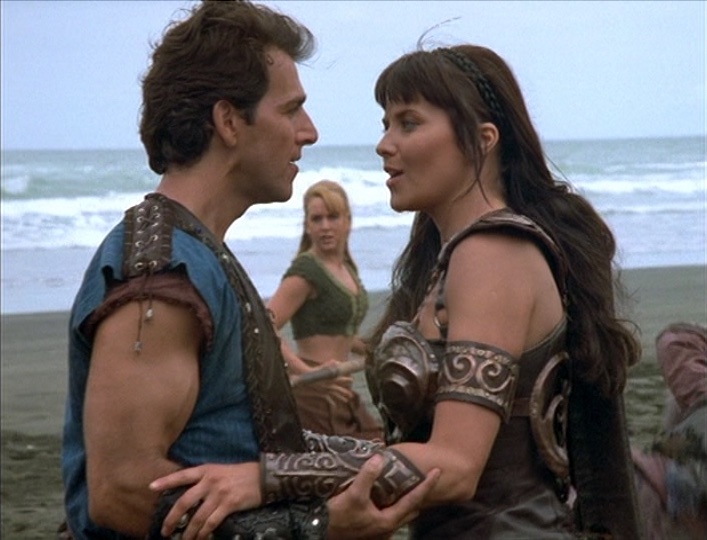
Ulysses (John D’Aquino) and Xena (Lucy Lawless) exchange post-fight admiration while Gabrielle (Renee O’Connor) looks on warily.
Several years later, D’Aquino would guest-star on Xena, and his appearance is considered by some controversial, since he seems to pose a threat to Xena and Gabrielle’s growing relationship. Also, some viewers didn’t find him convincing as Ulysses. I thought he was, and it’s clear to me that their relationship is due to the fact that they are soulmates of a different kind: they both draw inspiration from The Odyssey. This is even hinted at in this episode, as they compare notes and realize they’ve done the same kinds of things. When Xena says “I have many skills,” she’s actually quoting The Odyssey’s description of Ulysses. You might say they’re too similar: it doesn’t work out between them because they don’t need each other, and they have other people in their lives who need them more. And the women in their lives are becoming heroes in their own right, thanks to them.
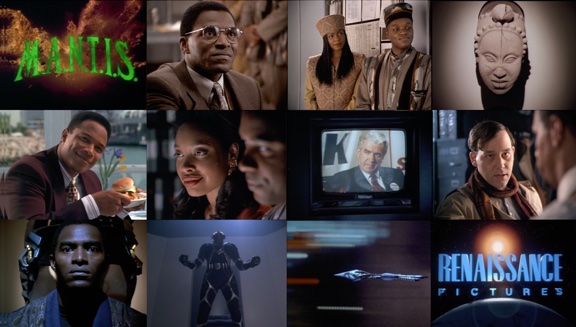
From left to right: Top row: 1)Title, 2) Carl Lumbly as Dr. Miles Hawkins (M.A.N.T.I.S.), 3) Wendy Raquel Robinson & Christopher M. Brown as Dr. Hawkins’ assistants, 4) African statue masking entrance to Dr. Hawkins’ secret laboratory. Middle row: 1) Bobby Hosea as Yuri Barnes, 2) Gina Torres as Dr. Amy Ellis, 3) Francis X. McCarthy as Chief Stark, 4) Sam Raimi as a student of the “University of Venus”. Bottom row: 1) Dr. Hawkins puts on the M.A.N.T.I.S. mask, 2) the full body M.A.N.T.I.S. exoskeleton, 3) one of the arrows shot by M.A.N.T.I.S. in mid-flight, 4) The old Renaissance Pictures logo
Right around the time that Sam Raimi and Rob Tapert produced a series of comic book-style movies that would serve as precursors to the Marvel and DC cinematic universes: the Darkman series and Timecop, they also produced M.A.N.T.I.S., a series that anticipates the Black Panther movies. The pilot has the energy of the other two, and beyond that, a social commentary that’s unusual in comic book films. Dr. Miles Hawkins is a billionaire, one of the richest men in Los Angeles (called Ocean City in this story), and eschews political identification. He’s a brilliant scientist as well, a black Bruce Wayne who can fight crime and outsmart it. He also doesn’t trust power: “Nobility is the best excuse in the world,” and “heroism is not to be trusted” are stand-out quotes in this film. His mansion is staffed with assistants from Africa, and decorated with African art disguising secret experiments to help improve the world, not to mention, restore his mobility after being shot in a city riot trying to rescue a child.
The city itself is not doing so well: riots constantly loom, between rival gangs, and the city’s police chief, Stark, is running for mayor on the unsubtle platform of “Take Back Our Streets.” He’s running against an African-American mayor presiding over the status quo. If you lived in Los Angeles in 1994 when this series debuted, you couldn’t help recognize the real-life references here: Chief Daryl Gates, and billionaire real estate developer Richard Riordan, who ran for mayor in 1993 after the longest serving African American mayor in the country, Tom Bradley, announced his retirement after two decades, following the infamous 1992 Rodney King riots. Gang warfare was a major issue in the city, as was police corruption, and its consequences would be felt in 1994 with the arrest of O.J. Simpson, and his controversial not guilty verdict in 1995.
There was a genuine sense, after 1992 that the city had neglected its non-white population. Local news coverage depicted two separate worlds: crime in the inner city, and positive depictions of city life in the suburbs. Coverage of politics, or race in any kind of non-stereotyped way, was virtually non-existent. The brutality of Rodney King’s beating, without any consequences for the police that beat him, made this great divide impossible to deny. Clearly, television in Los Angeles, entertainment capital of the world, had no clue what was happening in its own city.
Sam Raimi and Rob Tapert created the M.A.N.T.I.S. pilot depicting non-white Los Angeles for the newly emerging fourth television network, Fox. By the early Nineties, Fox was beginning to catch up to the “Big Three” networks, and just beginning to be taken seriously. The pilot featured a largely black cast, including Bobby Hosea as a network anchor, Gina Torres as a forensic doctor, and of course, Dr. Hawkins as the city’s billionaire. The white characters are seen with skepticism: Philip Baker Hall calls Dr. Ellis an Affirmative Action hire, and the anchorman’s boss at the station is focused on ratings. The police chief is the villain, allying with a community leader to inflame gang violence for their own political advantage. It’s pretty bold stuff! How did it end up at conservative-leaning Fox Broadcasting? I think they responded to the times, and the rest of their programming tried to mark out territory ignored by the Big Three, and the world of M.A.N.T.I.S. was clearly being ignored. They wanted edgy material that would challenge people’s assumptions, and the fact that Dr. “M.A.N.T.I.S.” Hawkins was himself a no-nonsense social conservative defied stereotypes.
Once the pilot was approved, dramatic changes were made to the series concept, however. The show was deemed too black, too urban and too realistic for their viewers, so the entire African-American cast was let go, except for its star. Dr. Hawkins’ colleagues were now various shades of white: a British tech expert who appears to be the source of M.A.N.T.I.S. technical wizardry, a bicycle messenger (apparently from Brooklyn, despite the show now taking place in a stand-in for Seattle) who is now responsible for coming up with the name MANTIS (no longer an acronym, as in the pilot), as well as lending regular guy street smarts to the M.A.N.T.I.S. team. Dr. Hawkins is no longer a billionaire genius, just a Dr. of biology who runs the company and can’t face getting out of his chair, and gets constantly scolded for it, including by his sassy domestic help, who replaces the Wakanda-style assistants in the pilot. Later on in the series, the show became increasingly fantasy-oriented, ending with Dr. Hawkins sacrificing his life for the white dudes by getting crushed by a Tyrannosaurus Rex (perhaps a nod to the fact that Jurassic Park: The Lost World, was taking over the set of the cancelled series). That kind of downward spiral of a tv concept is not new to the Fox Network, but in this case it really takes your breath away.
Both Rob Tapert and Sam Raimi’s names appeared on the show credits, but they abandoned the show after the pilot when they realized it would be butchered. This was their first successful attempt at a tv show, and it was Rob who was most eager to move into television. He learned from this experience, and quickly switched gears, creating Hercules: The Legendary Journeys and then Xena Warrior Princess for the syndicated market, and both he and Sam produced American Gothic for CBS (which was cancelled after a year). These shows were much less prone to network interference, outside of the obvious notes to remove extreme depictions of sex and violence (of which there was plenty, for just that reason). Hercules succeeded as a good guy that everybody could look up to, while the more problematic Xena received the benefit of being a spin-off that initially resembled its parent show, just long enough to establish its own audience. I can only imagine how Xena would have been deconstructed at Fox, to be more deferential to men, and less central to her own story.
There’s a lot of clever things in M.A.N.T.I.S. that we’ll see in later series and films by Renaissance Pictures. For example, Dr. Hawkins is non-violent. He neither develops weapons nor carries them in his crime-fighting (Fox Network turned him into a bioweapons developer, tsk tsk!). His main defensive tools are darts that inject a chemical that freezes his opponents. In other words, very much like Xena, he paralyzes his opponents briefly, and one can imagine this being used in future episodes as she did, as a method of interrogation. In the image above (bottom row, 2nd from right), you can see one of his projectiles as it’s being shot at a violent criminal. It roars through the air very much like Xena’s chakram!
Composer Joseph LoDuca created a nice Bernard Herrman style score, inspired by Hitchcock movies, and there’s a shout-out to Hitchcock at the very end, when Dr. Hawkins sends dedicated phones to his allies with a note: “Just dial “M”. This is clearly a reference to “Dial M for Murder.” In other words, the thuggish depiction of race and violence we usually saw characterizing the inner city would be replaced here by one of the most elegant detective mysteries that Hitchcock directed, and we can only imagine how this show would have evolved with that kind of wealth of inspiration.
I’m beginning the actual webcomic this week, and before I commit anything to expensive Bristol board, which I will ink and scan, then color in the computer, I need to do a quick rough layout to give me an idea of how the ink and color will work, so in order to cut costs while working on something similar, I ordered a case of dry cleaner shirtboards. These are 8 1/2 x 11″ cardboard pieces, white on one side, undyed cardboard on the other. They are nearly the same size as comic books, just a little larger. And they’re very cheap! I have enough to last me for the next several projects, with plenty to spare.
They also come with very pleasant creative associations for me. As a lad, I discovered that my grandfather kept all of his leftover shirtboards in the hallway cupboard. I didn’t have any fancy drawing materials, growing up. I’d use newsprint sheets borrowed from school, or in a drawing pad for kids. You couldn’t draw with gusto on newsprint, so having all these sturdy cardboard sheets was a new experience for me. And having that many blank sheets was an open invitation for me to create a story from those hundreds of boards. I don’t think I thought of myself as an artist at that point, but I definitely felt the call to fill in those boards with a long story worthy of all that space. That pretty much shaped my exceptions for the rest of my life: comics should be long and freewheeling, like comic strips, but unlike comic strips, they should have a story arc: a beginning, middle and end, like books or movies. I began to think in terms of epic stories that left the characters changed somehow. That was probably the first time I began to think in literary terms, I guess, for purely practical reasons.
The story I first created was quite involved, and I ended up displaying it at school as part of an art fair. I think the parents and students who saw it were a bit confused, since I was only allowed to display a small portion of it. My strengths as a storyteller were more in the writing than the drawing, so this was probably not the best forum for it. But it was my first taste of fame as a sequential storyteller.
As I began to organize my schedule for this webcomic, I realized this was the first time as an adult that I would be publishing such a story done entirely by me. I needed all the good vibes I could gather to myself, so during the writing of it, I’d try to recall every positive influence possible, anything that would make this effort as fun as possible, and as personally fulfilling, whether it was necessary to the process or not. There’s no reason I couldn’t just do this all on software: I have it, and enjoy using it, but I need to feel I have something in the real world, just in case. Physical media is the future, right?
At the last Xena Warrior Princess convention, this past January, I stopped by Adrienne Wilkinson’s charity booth (she’s the actress who played Eve and Livia, the stars of my story); she was selling memorabilia for a fundraiser, and I purchased several Xena comic books. They had the cardboard backing on them, the kind you use for vintage comics to preserve their integrity. The other day, as I was looking for some artist’s board I could use for a quick marker sketch of Livia, I spotted one of those comics, pulled the board out, and used it as my canvas. I liked the result because the surface was glossy, so I could smear the colored ink around as needed, and was exactly the same size as a comic book, so I could picture what the final result would look like if published. You can see the results here. I wouldn’t use this for my final art, but it gave me the freedom to play around with it.
Shirtboard is not quite as glossy, but a little shinier than matte Bristol board, so it’s sort of a compromise. It’s disposable, so I won’t feel inhibited using it, but good enough that I can get good results with it. Plus, seeing that tall stack of boards in the corner of my workroom, it reminds me of my first “graphic novel” experience, and I can’t help but wonder what those boards will look like when I’m done with them.
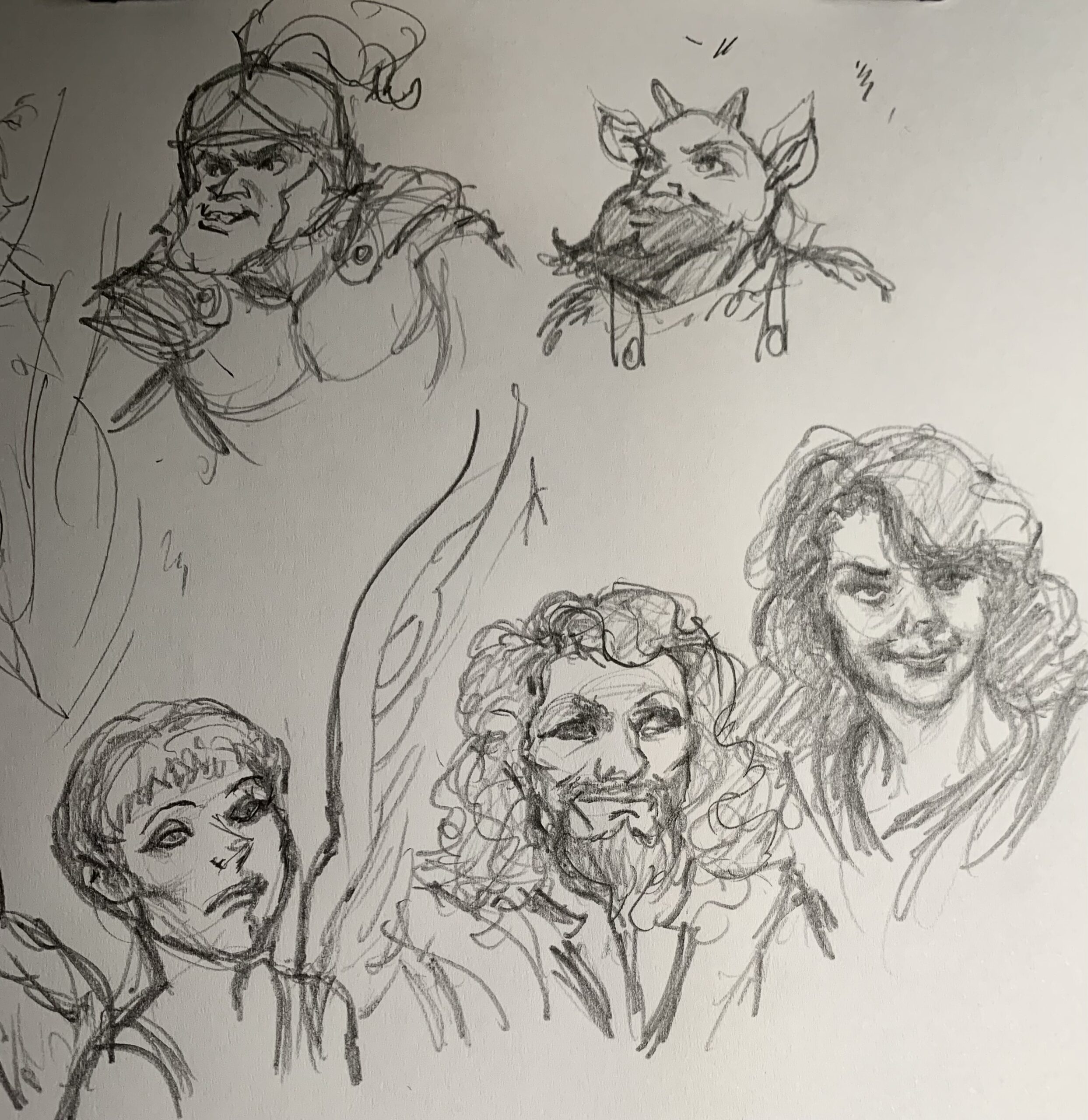
Tonight I did a few quick sketches for the prologue to my webcomic, based on Aeschylus’s lost comedy, Proteus*. I drew these from memory, so they don’t exactly match the performers I’m basing them on, but I mainly just wanted to see if I could capture the spirit of the characters, first.
Starting at the upper left is Menelaus, based on Bruce Campbell. I drew just enough to convince myself I could get the basic elements of his appearance. He has the biggest role, and despite the broad comedy, his actions are fairly nuanced, so I’ll have to work on those in context. To his left is the satyr character from Disney’s Hercules, sort of based on Danny Devito. Below at left is Helen of Troy, and it took me a number of tries to capture the effect I wanted: a comedic blend of hautiness, indignity, & sorrow. You can also see she’s sprouted wings, as she is the daughter of Zeus as a swan. She’s based on one of my favorite Hercules: the Legendary Journeys guest-stars, Lisa Chappell, who appears in a lot of the show’s screwball comedies. To her left is the title character, Proteus, half man half fish, the Greek god of change. He’s based on Michael Hurst, who also played a half man half fish on Hercules (among many other roles). At his left is his mischievous daughter, Dorothea, based on Xena guest star Sheeri Rappaport, who played Otere of the Northern Amazons. Sheeri had mentioned during her Xena convention appearance that she wished her schedule had permitted her to appear on Bruce’s show, Jack of All Trades. I think that could’ve been awesome to see her play opposite Bruce, and since my version of Proteus is very similar to that show, I thought I’d do some wishcasting and include her here.
This short webcomic is maybe five pages long, so a good chance to practice before I get started on the main event.
*In case you’re wondering: even though Aeschylus’s comedy is lost (except for a single line of dialogue), scholars can get a fair idea of the plot if they combine the story from Homer’s Iliad with known comedic tropes used by ancient Greek playwrights. I Xena-fied those tropes to adapt them to this show, and added a few more elements to help this story foreshadow the main webcomic. Key moments of my webcomic drew from this story for inspiration, just as Xena‘s episodes often borrowed from Greek myths, plays, and epics.
Here’s a quick sketch I did (15 minutes in pencil, 5 minutes to ink/color), a few days ago, because I really wanted to know what this would look like. I worked off of references I’d collected for a while, so the choices were already made. This is for a companion story to my “Rock of Ages” webcomic coming up. While that webcomic is set after the end of season 5 of Xena Warrior Princess, and concerns Eve, Xena’s daughter, this is from a prequel (working title: “Champions”), set right before the final trilogy of that season, which introduces her daughter as a Roman commander, Livia. This story gives us a glimpse of what Livia’s life was like just before her mother reappears after a 25 year absence (frozen in ice!).
This story goes into more detail about her pursuit of the Elijian cult, and since this story will run roughy concurrently to the main webcomic, it will reflect and parallel that story, to a fair degree. Unlike that main story, it’s not a musical, nor involves dance, but music plays a huge role in my creation of it, so I’ll be including links to those inspirational videos as a kind of closing credits score for each chapter.
This scene shows Livia prepared to track down that part of the Elijian cult that dares to reside in Rome’s capital city. Clues point to a downtown art gallery as being frequented by those with insurrectional ideologies, and since the Roman army is forbidden to enter the city itself, Livia decides to investigate and infiltrate them without alerting them of government interest. She’s dressed as an art aficionado, and armed with known slogans of the cult’s belief, to see who bites. The gallery’s owner, Antony Warholus, is a subversive artist and connoisseur of cultural critiques, just the sort of fellow who’d attract Rome’s most dangerous underground movement!
Livia’s dress is based on an actual psychedelic dress design. I chose it for its chakram-like pattern, and its painted ray appearance almost resembling a bloodsplatter. Her green glasses are similar to those worn by the actual Andy Warhol, and in ancient Rome, green-tinted glass was used like sunglasses, to filter out sunlight and soothe the eyes. I was determined to give Livia as many wardrobe changes as I could think of! The actor I based Antoney Warholus on is Stuart Devenie, who played the hilarious villain in Jack of All Trades.
I’m planning to make this parallel story in black and white, but for this one chapter, I will make an exception, since color variety is as important to it as it was to Warhol’s own creations.
I finally watched the Bob Dylan biopic A Complete Unknown, and it’s interesting to see the clash of artists during this formative period in rock music.
The movie opens with Dylan arriving in Greenwich village, and a montage of him walking the streets with a guitar strapped to his back looking every bit like the icon we now know, but in reality, he’s totally unremarkable, wandering a bleak cityscape. He passes by a bum begging for change who also plays a guitar, no doubt a musical predecessor who also had big dreams. He stops in a bar full of other musicians who barely give him a second glance until he asks where Woody Guthrie can be found. So, guitar+Guthrie: they get who he is, and dismiss him with some curt directions.
Dylan’s acoustic guitar is his ticket to see his idol, and gain an audience with Pete Seeger. Dylan’s mastery of folk tropes gains him respect of the old guard, who recognize the future of their art form when they hear it. Dylan seems to exude authenticity in an art form that demands it, though he says, and does, very little when he’s not singing.
Pete Seeger demonstrates the magical artistry of folk music when he leads an untrained audience in a beautiful & haunting rendition of one of his songs, and the real magic of folk, of course, is how it raises social awareness & helps organize political movements. Art makes social responsibility beautiful.
Dylan gets this, and feels the power that moves his audience. His songs capture his generation’s feelings with cutting force, and the folk industry see another movement leader arising in their midst.
But something happens to his music as he develops his craft. He draws upon more than just folk tropes and news events, but from Shakespeare, the Bible, and cinema, in a way that becomes, like those art forms, more about the timeless personal journey of the artist.
Dylan’s actual journey as an artist is a closed book: literally. He carries a scrapbook of his earlier years which contradicts his story that he’s a colorful drifter. His bio and his name are fabrications. Yet the feeling he conveys in his music seems genuine. His fictions are convincing, but what happens if he tries to break free of them?
Once he’s a breakout hit, he can’t go anywhere without being mobbed. It’s difficult to be a spiritual leader of a movement if you’re chased down by the people when you’re trying to live your life. Dylan is without his guitar in these scenes, and without it, he seems to shrink to nothing; only the crowds define him.
His success is derived from his well-chosen imagery, beginning with that acoustic guitar, but it comes crashing down when he reaches for a different guitar. The music he sings to electric accompaniment, “Maggie’s Farm” and “Like a Rolling Stone”, are powerful ballads, but they’re not folk ballads. We can see what frustration powers them: being forced to serve another’s agenda, and being cast out if you try to reclaim your freedom are exactly what happened to him.
To be sure, these are themes just as universal as the subjects of folk music, but they express the frustration of the individual, on the individual’s own terms. You’ll never get an audience to chant these songs in unison, because they’re introspective, not unifying.
That said, had Dylan started out writing this kind of music, how far would he have gotten? Who would publish it? Perhaps folk music provided a good launching point for his themes, but he was never destined to stay there, to the chagrin of his original sponsors. My first album of his I bought was as a member of the fictional, whimsical Traveling Wilburys, which seemed to suit his style as well as anything else he’s done, a role to slip in and out of, its truth in the moment of performance, in a band that seems to have been everywhere, but gathers no moss.
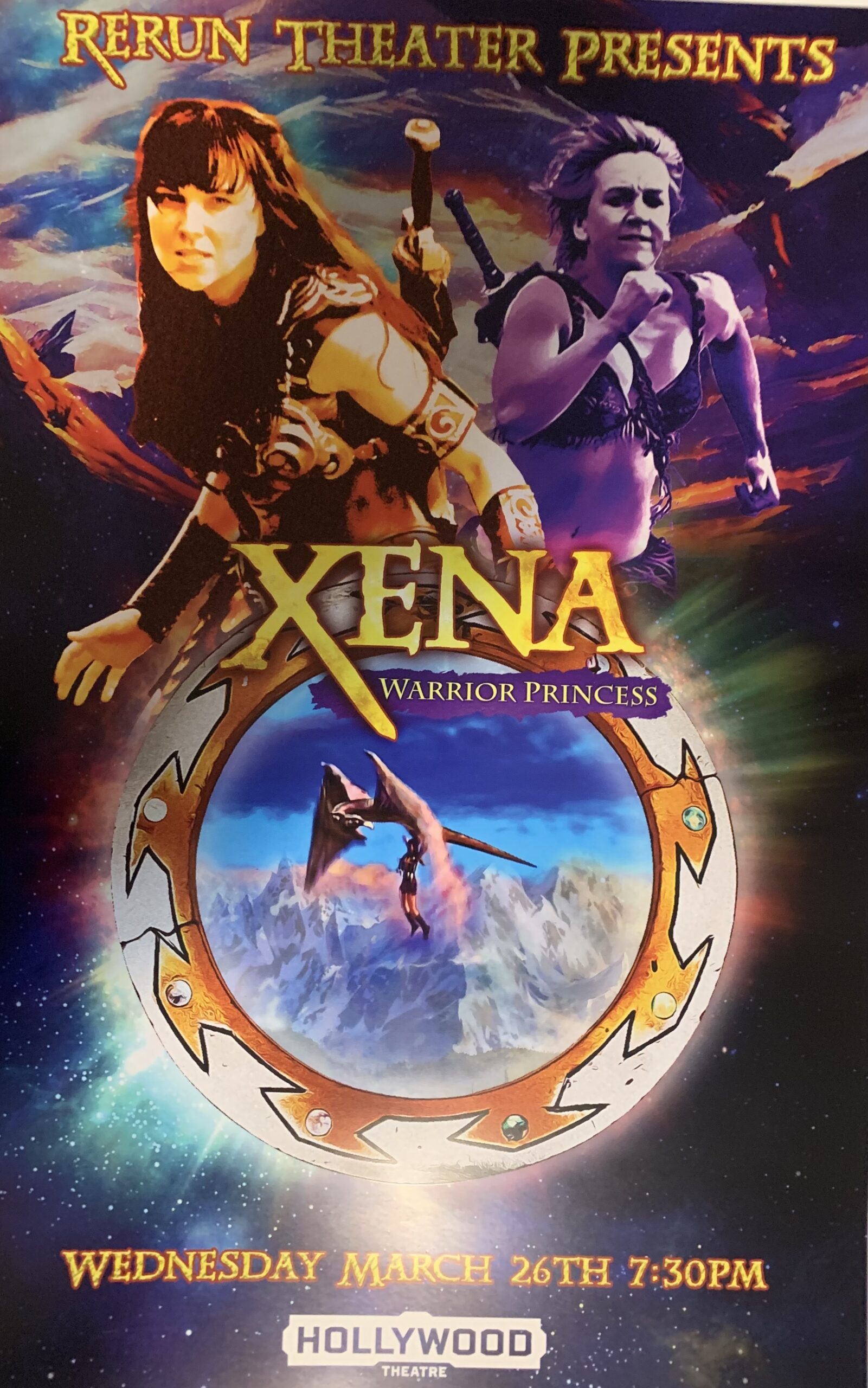
The last time I watched Xena Warrior Princess with commercial breaks was June 18th, 2001. Since then, fans have waited to see a new chapter of her story on the big screen, or at least, to see her existing stories replayed on the big screen, but in the 24 years since that last aired episode, I’ve never seen that actually happen…until just this last week! Two episodes of Xena were shown at the Hollywood Theatre in Portland, Oregon, with commercial breaks, using ads from the 1990s, when they first aired.
One might ask why bother doing that when you can watch them ad-free in the comfort of your own home, but having now gone through the process, it’s a whole different experience seeing them with an enthusiastic audience, plus, having to wait for 2 minutes of commercials before you can see a cliffhanger resolved restores the original pacing of the show, giving you some extra time to absorb what you’ve seen, and to prepare for the next plot twist. Hearing the audience pick up on every little detail means you get a much fuller appreciation for the story: a lot more of the show’s humor emerges, and the dramatic moments hit a little harder. This is true of any theatrical release, but we’re not used to that in a (non-sports) tv show, unless we’re watching with friends or family. TV in its earlier days was much more communal, with only one tv set in the house, and fewer channels to choose from. Much of my experience watching Xena was solitary, though I spent many hours discussing it after the fact in online forums, which were just emerging when the show first started airing, in 1995.
So it was a very different experience this last weekend to sit in a crowded theater sharing these episodes for the first time with others. They were presented by Rerun Theater, a group that collects vintage tv episodes, matches them with era-appropriate commercials, introduces them to the audience beforehand, and offers a commemorative poster for each showing. It’s a poignant experience to compare the image of women in the commercials with the non-traditional ground-breaking characters in Xena, providing a cultural snapshot of the show’s context, and how the show would eventually make its own impact on the culture. You could hear the audience snicker or gasp as each commercial came on, and there was a lot of conversation to be overheard as we all left the theater.
For myself, having waited 24 years to see Xena on the big screen, I asked myself beforehand why these two particular episodes were chosen. I wondered why they didn’t choose the pilot instead, or one of the more cinematic two-part episodes later on that more closely resembled the kind of martial arts films that Hollywood Theatre often showcased. Having now seen them back to back, I think they were a good choice, especially for first-time viewers, because they provide a lot of exposition, and help give a taste of what we’ll see in the coming seasons.
Callisto, (Season 1, episode 22):
Callisto opens with a scene familiar to Xena’s past life, a village being ransacked by warlords, led by a woman calling herself Xena. We later discover this person is actually Callisto, a former survivor of one of her raids, and is now carrying on Xena’s crimes in her name, daring her to stop her. It sounds psychotic, but it’s the closest thing to justice that Callisto can imagine, given that the alternative is letting Xena find redemption in good deeds and making amends, while her own life has been forever scarred. Callisto had her parents taken away from her by Xena, and no doubt sought the safety of other warlords who could teach her their ways. If there is no justice, then the next best thing is to learn to use Xena’s own force against her, and that means using her tactics. There’s no future in her strategy, but she doesn’t believe in the future anyway, outside of Xena, the all-powerful force in her life, to whom she’s drawn like a soulmate. It’s as if she feels Xena is the only one who can understand her, and so she has remade herself in Xena’s image.
Even after she’s been arrested, Callisto can’t quit Xena
This is demonstrated at their first encounter, when Callisto becomes one of the few who can successfully catch Xena’s signature weapon, the chakram, and carry it as her own. The chakram seems to be a weapon powered by the will, and certainly, Callisto’s will for destruction matches Xena’s when she first received the weapon as Ares’ student, many years before.
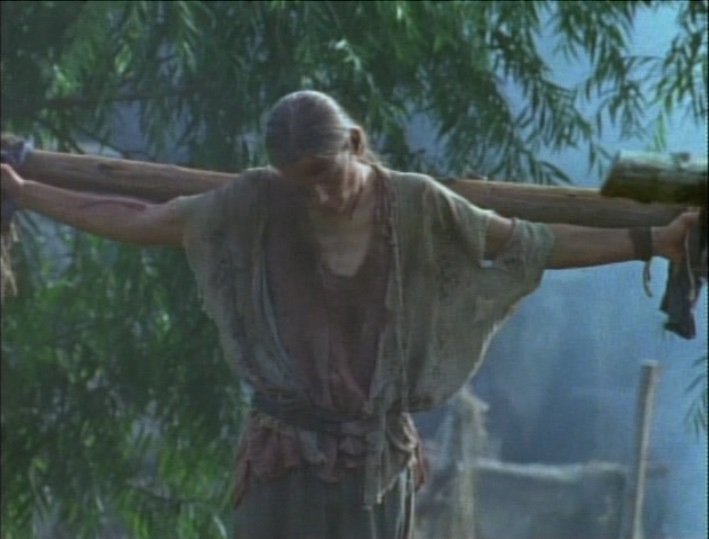
Callisto’s victims on the cross, men, women & children
It’s interesting to see that Callisto’s preferred method of torment is to crucify villagers, something that her reincarnated self, Livia, will do 25 years later, in season five. Callisto seeks satisfaction in an act of mutual destruction with Xena, after which, she craves only oblivion in death. As we’ll see, seasons later, she never finds it. It takes two lifetimes to finally achieve some kind of lasting peace, after which she truly does become soulmates with Xena, when she is reborn as her child.
Callisto aired near the end of season one, as the writing staff was preparing season 2, in which the show would begin to develop its character arcs, and introduce elements that would dominate the rest of the series. The show’s seemingly casual episodic approach pretty much ends with Callisto, and her story would be woven through the others in one form or another until very near the series’ end.
Prometheus (Season 1, episode 8):
The next episode, Prometheus, was aired much earlier in season one, #8, just a few episodes before the pivotal Hooves and Harlots episode, in which Gabrielle’s first great story arc begins, as heir to the Amazon throne, an arc which will last about as long as Callisto’s, through nearly the end of season six. Soon, Gabrielle will learn to wield a weapon, but in Prometheus, she’s starting to feel like a fifth wheel from her lack of fighting skills. During one battle scene, she just cringes by the wall as the rest of them fight. By the time Callisto comes around, she’s able to handily beat up Joxer, who prides himself as a great warrior. So this episode sets up her dissatisfaction as Xena’s comedy relief, and is no longer content to just be Xena’s chronicler, but her genuine sidekick and pupil. Xena still sees her as a bard and chronicler, however, and the first hint of a story arc is given when Xena makes it clear she needs to plan for the future by attending the Athens Academy of Performing Bards, something Gabrielle will do later this season.
This episode is one of only two with guest-star Hercules, from Xena’s parent show, Hercules: The Legendary Journeys. Xena began on that show, and now in its eighth episode, it once again is pulling viewers from HTLJ to take a second look at Xena, to see how it’s coming along, and it’s just in time for Gabrielle to indicate she’s ready to step up, learning a few lessons from Hercules’ sidekick, Iolaus himself. To capture these new viewers, both couples seem to pair up romantically, and Gabrielle brings up the subject of soulmates, with Iolaus. Clearly, she hasn’t been around him long enough to have such feelings, but given her youth, the intensity of their adventure, with lives at stake, and Xena’s emotional reunion with Hercules, the man who restored her faith in heroism and forgiveness, and it’s understandable that strong feelings would take over—and just as quickly dissipate. For the Hercules viewers, though, it’s a signal that they’d better keep an eye on things over on Xena’s show, because these gals are obviously going to be relevant in their lives, especially if they’re hinting about becoming soulmates!
Savvy viewers would know better than take this at face value, since anyone who dates any of these folks are doomed to become redshirts, but there’s no doubt the audience understands how these tropes work: once Hercules viewers get hooked on Xena, they’ll watch for their own reasons, and there’s no better way to establish one’s hero bonafides than to have them on an equal relationship footing with another hero. Instantly, Gabrielle is elevated to Iolaus’s status as action hero after she connects with him about it, even though she has yet to actually fight, and it won’t be long before she assumes the role in her own right. We’ll see this later on in season five, when daughter Livia manages to reach Xena’s level of accomplishment as a warlord, and then later, as a powerful force for peace, something we learn later Xena will accomplish in her next life.
There’s a bit of a reprisal of Xena’s first guest-shot on The Warrior Princess, when we see Hercules and Xena at odds over who gets to wield the sword that can free Prometheus. We eventually learn that releasing Prometheus is a death sentence for the wielder of the sword, and they are fighting for the chance to conduct a suicide mission, something they didn’t want to tell their sidekicks for fear they would want to talk them out of it. Here we also see a bit of foreshadowing of the questions in Xena’s final episode, in which Xena again has a secret agenda about her own possible sacrifice.
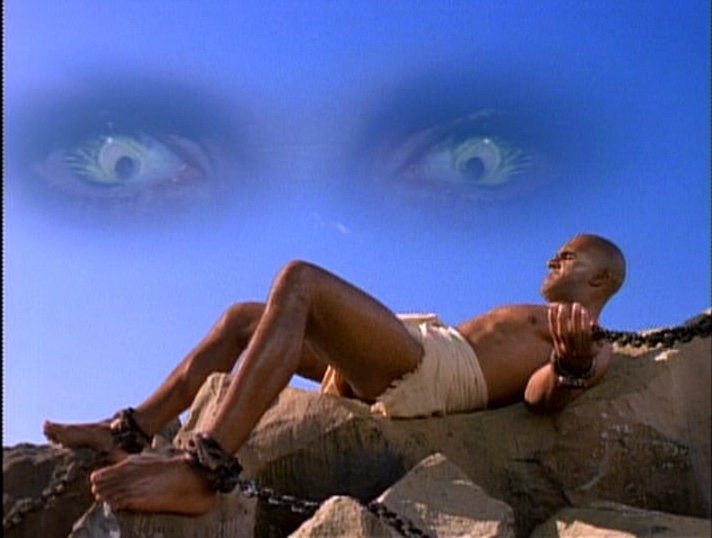
Hera keeping 2 close eyes on Prometheus
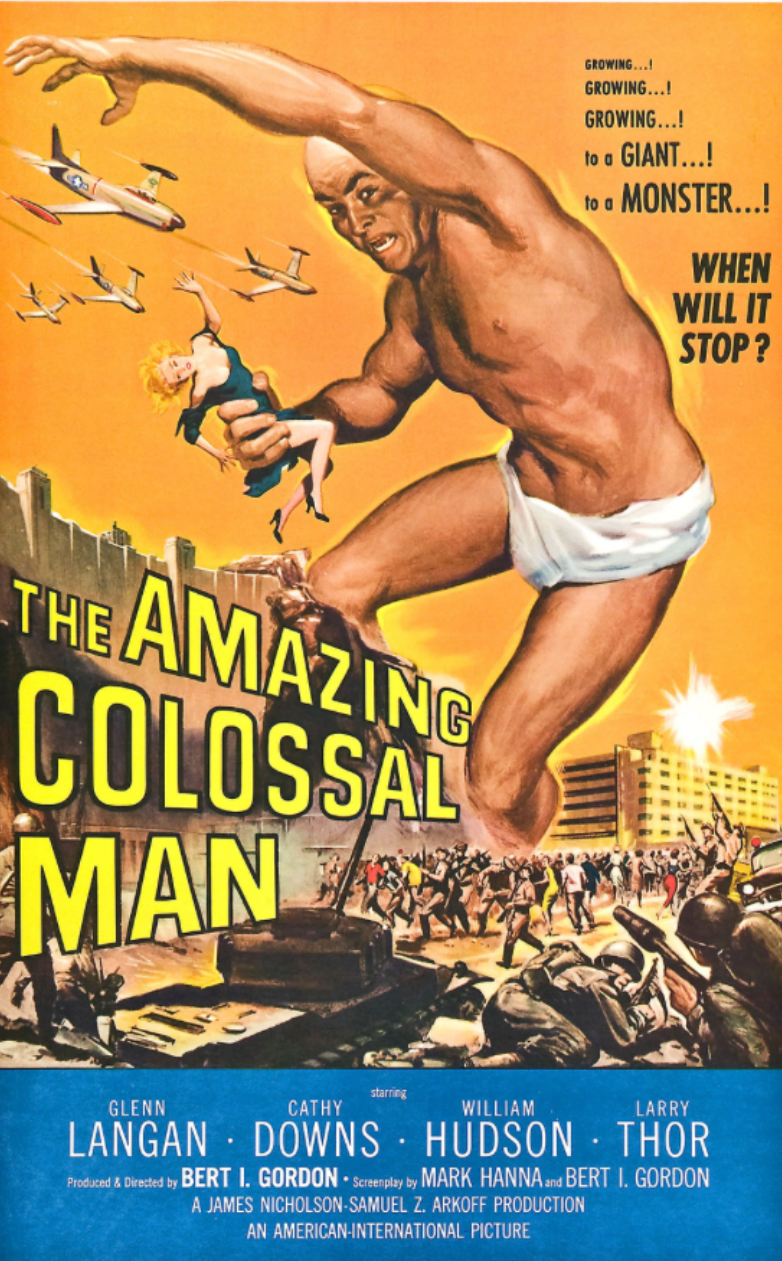
The title character, Prometheus, is a giant chained to a mountainside, and doesn’t really interact with the main characters. He speaks only with Hera, at the beginning, but there’s possibly some interesting subtext in how he’s presented. He’s not dressed like the usual Xena demigod, nor does he resemble any of the brutish giants we’ve seen. He’s bald, and wears only a brief white garment about his waist. If you’re familiar with classic science fiction movies, you’ll recognize this look: the title character in The Amazing Colossal Man.
The Amazing Colossal Man
It’s a story about a Lt Colonel who survives a plutonium explosion during the nuclear tests of the 1950s, causing him to grow indefinitely, driving him mad in the process. It can be a metaphor for the atom bomb’s power in the arms race. Here, Prometheus is being punished for giving mankind too much power in the form of fire, and healing, and certainly, atomic energy is a similarly godlike form of power. References to nuclear energy, and its ties to Oppenheimer’s quote from the Bhagavad Gita occur in various forms throughout Xena, and we’ll see more explicit forms of this metaphor repeated in season 6, in Send in the Clones (featuring the ominously named Alexis Los Alamos), and in the series finale, in which Xena seems to ignite an ancient form of the atom bomb in the ultimate battle against the armies of the demonic Eater of Souls.
These initial episodes are a good introduction to some of the character arcs and motifs that will be developed to great effect in future seasons. Some of them are quite heavy and profound, but they are quietly introduced and seem to grow organically before our eyes without ever weighing down the show with important messages, but never abandoning the universal concerns that the original myths illustrated with a similar effortless economy and light touch.
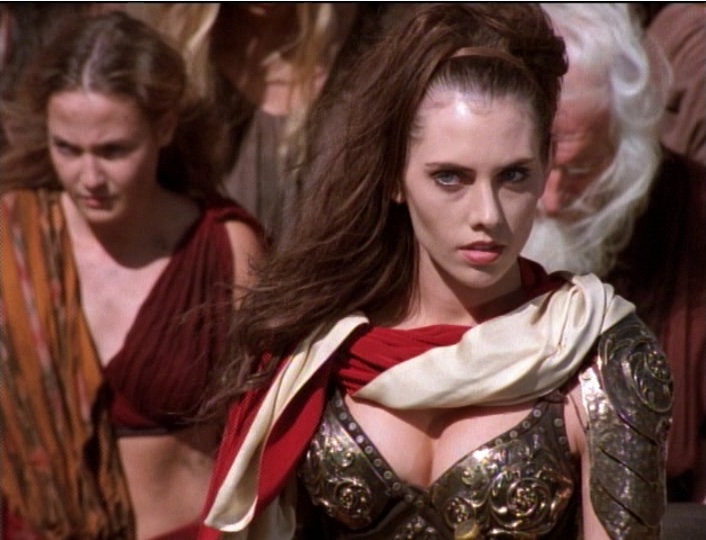
While watching “Livia”, I noticed something new: when she’s presenting captured Elijians as slaves to the Emperor, one gal right behind her is wearing virtually the same outfit she will as Eve!
That background actor was standing farther away in the establishing shot, but for this close up, they moved her right beside her.
I don’t know if they’d already designed Eve’s costume yet, 2 eps prior, but clearly they were thinking of the latest in Elijian fashion!
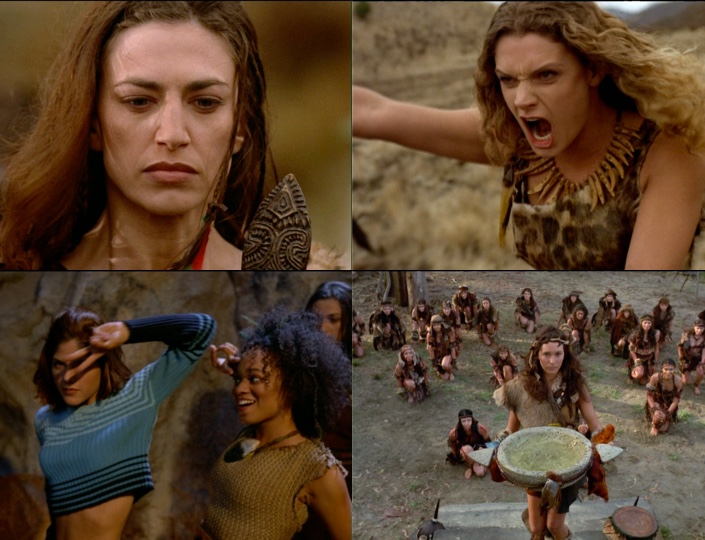
Top left to bottom right: Karina (Claudia Black), Samsara (Danielle Cormack), Cyane (Selma Blair), Olan (Monica McSwain), Eve’s Rite of Caste ceremony, in Lifeblood, Xena Warrior Princess.
Rewatching season 5’s Xena episode, Lifeblood, I noticed a few things for the first time that were impossible to realize before, when it first aired. This was an awkward episode, using an unrelated series pilot, Amazon High, in flashbacks for this story about the Northern Amazons, and Eve’s Rite of Caste ceremony. It seemed a story filled with elements that didn’t quite fit together, and seemed to rewrite the literal rules of shamanism that the tribe was associated with. That, and the odd tonal juxtaposition between the tragic backstory of these Amazons, and the pilot, a fish-out-of-water comedy set in the prehistoric age.
That said, this time around I didn’t worry about any of that, and just took in the images, and the themes, and it suddenly made more sense. What brings it all together, in my mind, is Eve’s presence. Her potential baptism by blood, exactly what Xena wishes to avoid for her, is eventually reimagined as a baptism by water blessed by the tribe. This actually makes perfect sense, given what we eventually learn about Eve’s fate: as her parents lie frozen, she will indeed be baptized by blood, and redeemed in a ceremony by the Baptist, made possible by a vision not unlike the vision Xena sees with the aid of the tribe’s Atma dagger, a glimpse into the original purity of one’s origin.
Since we have no idea any of this will happen, the first time we watch Lifeblood, we merely consider Eve the MacGuffin of this story, and the real story is Yakut unable to cross over into the next life because of the Amazons’ embrace of vengeance and bloodlust. The tonal shift of her somber concern with the antics of the flashbacks shake our confidence in the story’s unity and message, but if we can look past that, there’s actually a lot of underlying unity.
One of the big influences on both Hercules The Legendary Journeys and Xena Warrior Princess, according to Rob Tapert, was Michael Crichton’s book, Eaters of the Dead (later made into a movie, The Thirteenth Warrior). Based on the true account of a diplomate from an advanced civilization of the 10th century, the Abbasid Caliph, sent to Viking territory to understand their ways. His written account gives us a glimpse of the Viking world which seemed quite savage to him. Crichton adds a fantasy element to this story: The diplomat arrives just as the Vikings are encountering an even more ancient and savage race. They’re a separate branch of the human species altogether: a matriarchal tribe of cannibalistic Neanderthals, with whom no diplomacy is possible. Their ways and their motives are completely alien to the Vikings and the Caliphate diplomat, and it’s made clear that their violent confrontation with will be memorialized in much more familiar terms: as dragons and goblins in the legend of Beowulf.
Amazon High includes these elements as well. The enemies of the Amazons are much like these Neanderthals, and on the occasion when they speak English, we’re almost taken aback, given their animalistic savagery. They’re cannibals as well, having eaten all the men in the heroes’ tribe. The Amazons’ last surviving man is much like the shamans we’ll see later, and holds the secret for summoning a hero from the future. This hero, Cyane, is befriended by Olan, a gal who has the gift for talking to animals, another key shamanistic trait. In fact, her name, “Olan”, is a Siberian Yakut word for shaman (it means literally “arctic hysteria”), which indicates that the show’s research into Siberian shamanism was well underway at this point. Since shamanism also has a Viking connection, in the form of berserkers who became like bears, we see how Eaters of the Dead has possibly influenced this episode as well.
Olan is played by Monica McSwain, by the way, who is the best dancer the Amazons will ever have in any of these episodes! No surprise, since she is a professional dancer and choreographer. There’s good chemistry between her and Cyane (Selma Blair), and in the final celebration dance, we see Cyane introducing dance moves from Pulp Fiction and other 20th century sources, while Olan translates them into much more florid and expressive Amazonian movements. It’s unfortunate we never get to see more of them in a series.
The leader of these ancient Amazons, Karina (Claudia Black), is a visionary of another type, able to transform the surviving members of her tribe into what I assume would be the leading power of their day. Samsara (Danielle Cormack), embodies the fury of the Amazons that we will recognize in later years in characters such as Varia, whom Eve will have to contend with. These are the two archetypes that help shape the depiction of the Amazons on these shows, and one could argue that without Karina’s visionary leadership, the Amazons remain what they are in Lifeblood: a Paleolithic tribe cut off from the rest of humanity, an isolation that might possibly end in season 6, when Eve makes her last appearance in Path of Vengeance.
We see this Eaters of the Dead pattern throughout HTLJ and XWP, into its final season, in the episode The Abyss (which was also originally supposed to include Eve, interestingly enough), a story about a savage race of cannibals seemingly incapable of any kind of speech. Eve herself plays the diplomat between the advanced civilization of Rome, and the Paleolithic Amazons, in Path of Vengeance, as a way to bring them out of their endangered state of isolation. Her mission is interrupted when her bloody past renders her an ineffective messenger of peace. No doubt this leads to her decision to head to India and Ch’in.
When the Amazon High pilot was shelved, it took new form as the bold opener for season 4 of XWP, Adventures in the Sin Trade. The bleak landscapes and gloomy cave settings for Amazon High return, only this time filmed in the epic tones we’d see in The Debt. There are no adults in this tribe: like the men in Lifeblood, the adults have all been killed. Cyane as reluctant leader now takes the form of Otere, and Olan with the Yakut-inspired name is now literally named Yakut! The tribe is hunted by Alti, a shamaness, who summons a berserker, a figure appearing in Norse religious practices. This new incarnation of Amazon High, amongst the Northern Siberians, pops up here and there over three seasons of Xena, finally appearing in To Helicon and Back, when the confrontation that would’ve likely occurred between Karina and Samsara is now fulfilled by Gabrielle and Varia.
No idea goes wasted in the world of Xena and Hercules, however, so I believe we do eventually see Amazon High go to series in the form of Cleopatra 2525. The world of caves and sparsely populated surfaces of roaming saber-tooth tigers, horses and mammoths in prehistoric times are now a dystopian future, with steel caves and Baileys, floating mammoth robots who are just as alien and incommunicative as the Neanderthals in Eaters of the Dead. This time the adults of Amazon High reappear: Karina is now Hel (a name from Norse myth), and Samsara is Sarge. The Atma dagger is Voice, which only Hel can hear, making her a kind of futuristic shaman. Cyane is Cleopatra, of course, from the past now, not the future, but still full of 20th century anachronisms. The villain wears garish makeup, a bit like some of the men of Amazon High, and it’s even hinted at the end that he may be a time traveler, too, which is a plot point that we may eventually have seen on Amazon High. We can see another connection to Amazon High in the title of its pilot: Quest for Fire Power, is a play off of the film about humanity’s first use of fire in the Paleolithic age, Quest for Fire.
These are things I keep in mind as I work through my own Eve-related project, because I think there’s unfinished business between Eve and the Amazons that doesn’t get fully explored, since they likely held them over to develop for an Eve series, which, like Amazon High, did not get off the ground, unfortunately. But to me, there’s a lot of instances on the show, like Amazon High, that are ideas that manifest themselves here and there, and help inspire stories, but don’t necessarily get fully realized, and it’s those ideas these days that intrigue me the most these days.
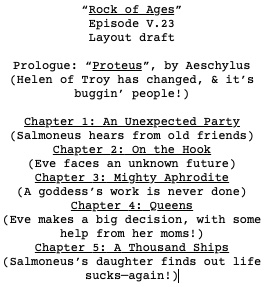
I have finished the full script, incorporating all notes and feedback, and I’m very confidant, going forward. Here’s what I’m working on for the month of March, 2024: the prologue for my Xena-related webcomic, and layouts for the first 5 chapters of the main story. I’ve included working chapter titles and a brief description of its contents. I’ll publish any images that look intriguing as I go through it: