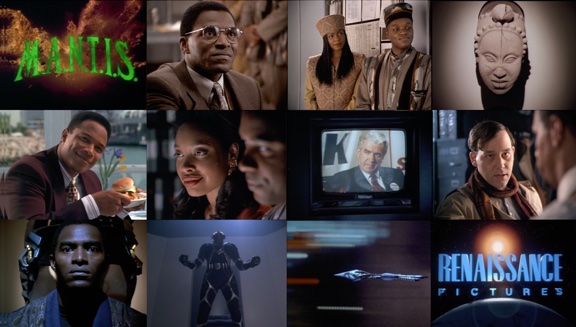
From left to right: Top row: 1)Title, 2) Carl Lumbly as Dr. Miles Hawkins (M.A.N.T.I.S.), 3) Wendy Raquel Robinson & Christopher M. Brown as Dr. Hawkins’ assistants, 4) African statue masking entrance to Dr. Hawkins’ secret laboratory. Middle row: 1) Bobby Hosea as Yuri Barnes, 2) Gina Torres as Dr. Amy Ellis, 3) Francis X. McCarthy as Chief Stark, 4) Sam Raimi as a student of the “University of Venus”. Bottom row: 1) Dr. Hawkins puts on the M.A.N.T.I.S. mask, 2) the full body M.A.N.T.I.S. exoskeleton, 3) one of the arrows shot by M.A.N.T.I.S. in mid-flight, 4) The old Renaissance Pictures logo
Right around the time that Sam Raimi and Rob Tapert produced a series of comic book-style movies that would serve as precursors to the Marvel and DC cinematic universes: the Darkman series and Timecop, they also produced M.A.N.T.I.S., a series that anticipates the Black Panther movies. The pilot has the energy of the other two, and beyond that, a social commentary that’s unusual in comic book films. Dr. Miles Hawkins is a billionaire, one of the richest men in Los Angeles (called Ocean City in this story), and eschews political identification. He’s a brilliant scientist as well, a black Bruce Wayne who can fight crime and outsmart it. He also doesn’t trust power: “Nobility is the best excuse in the world,” and “heroism is not to be trusted” are stand-out quotes in this film. His mansion is staffed with assistants from Africa, and decorated with African art disguising secret experiments to help improve the world, not to mention, restore his mobility after being shot in a city riot trying to rescue a child.
The city itself is not doing so well: riots constantly loom, between rival gangs, and the city’s police chief, Stark, is running for mayor on the unsubtle platform of “Take Back Our Streets.” He’s running against an African-American mayor presiding over the status quo. If you lived in Los Angeles in 1994 when this series debuted, you couldn’t help recognize the real-life references here: Chief Daryl Gates, and billionaire real estate developer Richard Riordan, who ran for mayor in 1993 after the longest serving African American mayor in the country, Tom Bradley, announced his retirement after two decades, following the infamous 1992 Rodney King riots. Gang warfare was a major issue in the city, as was police corruption, and its consequences would be felt in 1994 with the arrest of O.J. Simpson, and his controversial not guilty verdict in 1995.
There was a genuine sense, after 1992 that the city had neglected its non-white population. Local news coverage depicted two separate worlds: crime in the inner city, and positive depictions of city life in the suburbs. Coverage of politics, or race in any kind of non-stereotyped way, was virtually non-existent. The brutality of Rodney King’s beating, without any consequences for the police that beat him, made this great divide impossible to deny. Clearly, television in Los Angeles, entertainment capital of the world, had no clue what was happening in its own city.
Sam Raimi and Rob Tapert created the M.A.N.T.I.S. pilot depicting non-white Los Angeles for the newly emerging fourth television network, Fox. By the early Nineties, Fox was beginning to catch up to the “Big Three” networks, and just beginning to be taken seriously. The pilot featured a largely black cast, including Bobby Hosea as a network anchor, Gina Torres as a forensic doctor, and of course, Dr. Hawkins as the city’s billionaire. The white characters are seen with skepticism: Philip Baker Hall calls Dr. Ellis an Affirmative Action hire, and the anchorman’s boss at the station is focused on ratings. The police chief is the villain, allying with a community leader to inflame gang violence for their own political advantage. It’s pretty bold stuff! How did it end up at conservative-leaning Fox Broadcasting? I think they responded to the times, and the rest of their programming tried to mark out territory ignored by the Big Three, and the world of M.A.N.T.I.S. was clearly being ignored. They wanted edgy material that would challenge people’s assumptions, and the fact that Dr. “M.A.N.T.I.S.” Hawkins was himself a no-nonsense social conservative defied stereotypes.
Once the pilot was approved, dramatic changes were made to the series concept, however. The show was deemed too black, too urban and too realistic for their viewers, so the entire African-American cast was let go, except for its star. Dr. Hawkins’ colleagues were now various shades of white: a British tech expert who appears to be the source of M.A.N.T.I.S. technical wizardry, a bicycle messenger (apparently from Brooklyn, despite the show now taking place in a stand-in for Seattle) who is now responsible for coming up with the name MANTIS (no longer an acronym, as in the pilot), as well as lending regular guy street smarts to the M.A.N.T.I.S. team. Dr. Hawkins is no longer a billionaire genius, just a Dr. of biology who runs the company and can’t face getting out of his chair, and gets constantly scolded for it, including by his sassy domestic help, who replaces the Wakanda-style assistants in the pilot. Later on in the series, the show became increasingly fantasy-oriented, ending with Dr. Hawkins sacrificing his life for the white dudes by getting crushed by a Tyrannosaurus Rex (perhaps a nod to the fact that Jurassic Park: The Lost World, was taking over the set of the cancelled series). That kind of downward spiral of a tv concept is not new to the Fox Network, but in this case it really takes your breath away.
Both Rob Tapert and Sam Raimi’s names appeared on the show credits, but they abandoned the show after the pilot when they realized it would be butchered. This was their first successful attempt at a tv show, and it was Rob who was most eager to move into television. He learned from this experience, and quickly switched gears, creating Hercules: The Legendary Journeys and then Xena Warrior Princess for the syndicated market, and both he and Sam produced American Gothic for CBS (which was cancelled after a year). These shows were much less prone to network interference, outside of the obvious notes to remove extreme depictions of sex and violence (of which there was plenty, for just that reason). Hercules succeeded as a good guy that everybody could look up to, while the more problematic Xena received the benefit of being a spin-off that initially resembled its parent show, just long enough to establish its own audience. I can only imagine how Xena would have been deconstructed at Fox, to be more deferential to men, and less central to her own story.
There’s a lot of clever things in M.A.N.T.I.S. that we’ll see in later series and films by Renaissance Pictures. For example, Dr. Hawkins is non-violent. He neither develops weapons nor carries them in his crime-fighting (Fox Network turned him into a bioweapons developer, tsk tsk!). His main defensive tools are darts that inject a chemical that freezes his opponents. In other words, very much like Xena, he paralyzes his opponents briefly, and one can imagine this being used in future episodes as she did, as a method of interrogation. In the image above (bottom row, 2nd from right), you can see one of his projectiles as it’s being shot at a violent criminal. It roars through the air very much like Xena’s chakram!
Composer Joseph LoDuca created a nice Bernard Herrman style score, inspired by Hitchcock movies, and there’s a shout-out to Hitchcock at the very end, when Dr. Hawkins sends dedicated phones to his allies with a note: “Just dial “M”. This is clearly a reference to “Dial M for Murder.” In other words, the thuggish depiction of race and violence we usually saw characterizing the inner city would be replaced here by one of the most elegant detective mysteries that Hitchcock directed, and we can only imagine how this show would have evolved with that kind of wealth of inspiration.