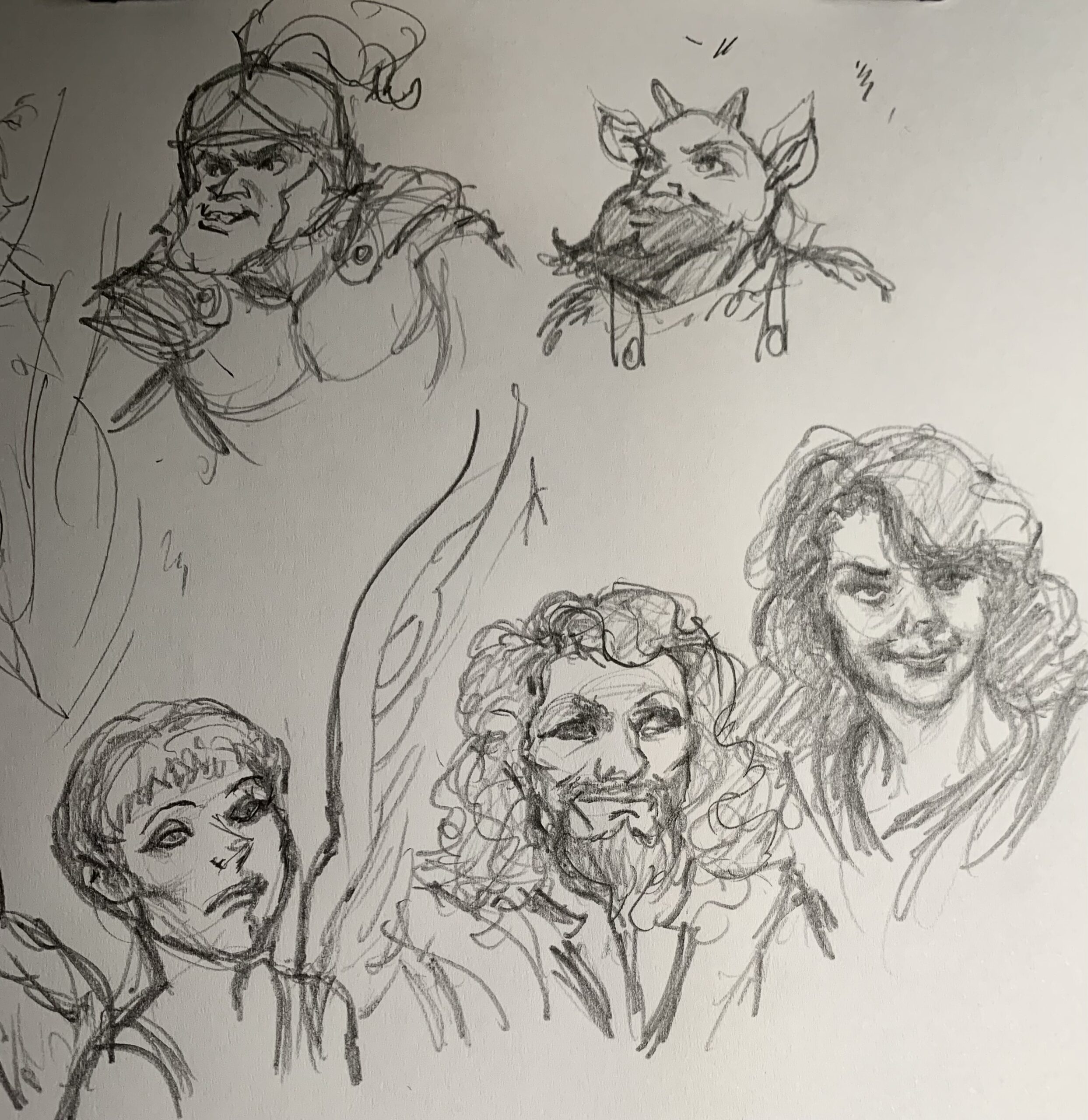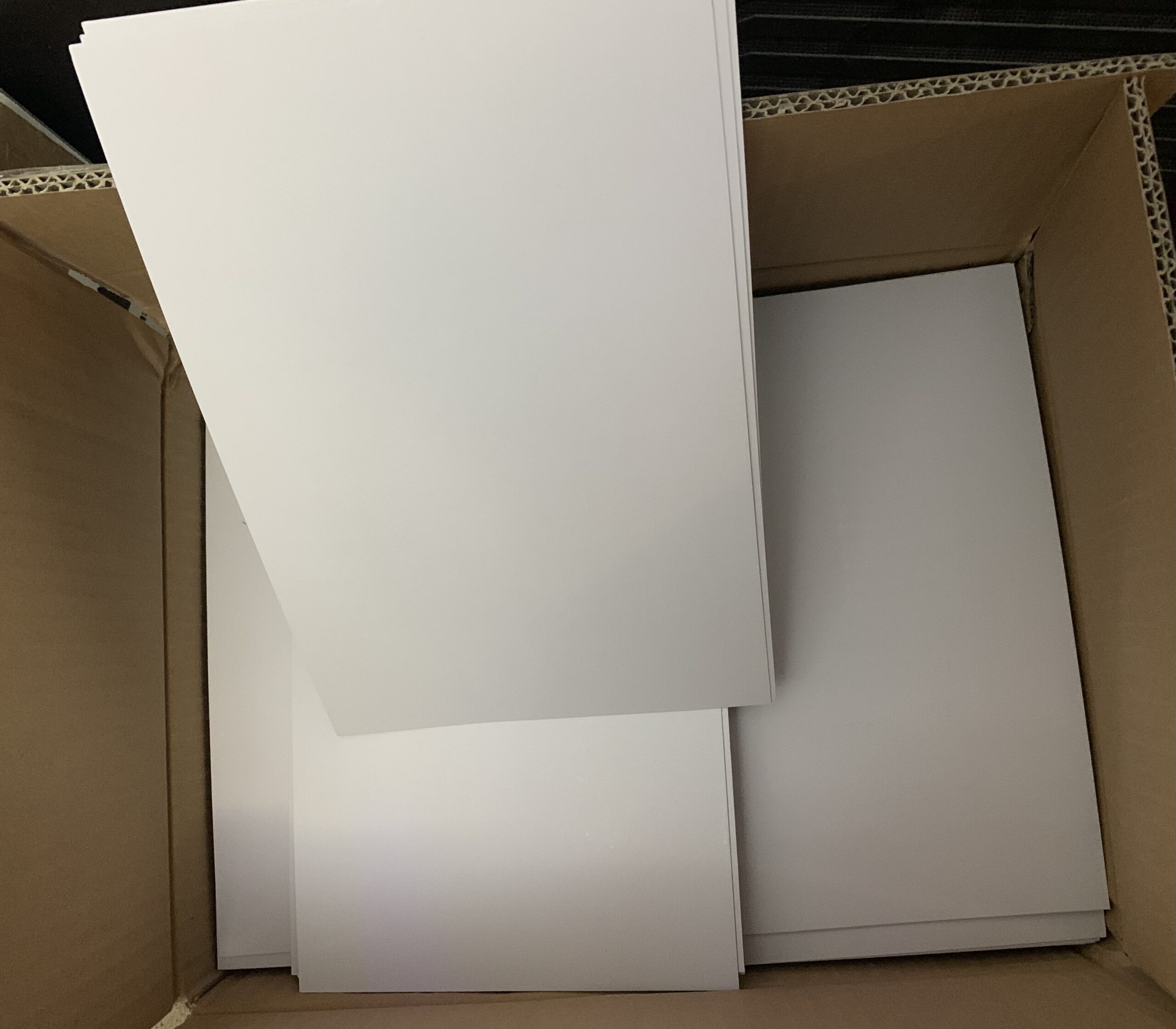
I’m beginning the actual webcomic this week, and before I commit anything to expensive Bristol board, which I will ink and scan, then color in the computer, I need to do a quick rough layout to give me an idea of how the ink and color will work, so in order to cut costs while working on something similar, I ordered a case of dry cleaner shirtboards. These are 8 1/2 x 11″ cardboard pieces, white on one side, undyed cardboard on the other. They are nearly the same size as comic books, just a little larger. And they’re very cheap! I have enough to last me for the next several projects, with plenty to spare.
They also come with very pleasant creative associations for me. As a lad, I discovered that my grandfather kept all of his leftover shirtboards in the hallway cupboard. I didn’t have any fancy drawing materials, growing up. I’d use newsprint sheets borrowed from school, or in a drawing pad for kids. You couldn’t draw with gusto on newsprint, so having all these sturdy cardboard sheets was a new experience for me. And having that many blank sheets was an open invitation for me to create a story from those hundreds of boards. I don’t think I thought of myself as an artist at that point, but I definitely felt the call to fill in those boards with a long story worthy of all that space. That pretty much shaped my exceptions for the rest of my life: comics should be long and freewheeling, like comic strips, but unlike comic strips, they should have a story arc: a beginning, middle and end, like books or movies. I began to think in terms of epic stories that left the characters changed somehow. That was probably the first time I began to think in literary terms, I guess, for purely practical reasons.
The story I first created was quite involved, and I ended up displaying it at school as part of an art fair. I think the parents and students who saw it were a bit confused, since I was only allowed to display a small portion of it. My strengths as a storyteller were more in the writing than the drawing, so this was probably not the best forum for it. But it was my first taste of fame as a sequential storyteller.
As I began to organize my schedule for this webcomic, I realized this was the first time as an adult that I would be publishing such a story done entirely by me. I needed all the good vibes I could gather to myself, so during the writing of it, I’d try to recall every positive influence possible, anything that would make this effort as fun as possible, and as personally fulfilling, whether it was necessary to the process or not. There’s no reason I couldn’t just do this all on software: I have it, and enjoy using it, but I need to feel I have something in the real world, just in case. Physical media is the future, right?
At the last Xena Warrior Princess convention, this past January, I stopped by Adrienne Wilkinson’s charity booth (she’s the actress who played Eve and Livia, the stars of my story); she was selling memorabilia for a fundraiser, and I purchased several Xena comic books. They had the cardboard backing on them, the kind you use for vintage comics to preserve their integrity. The other day, as I was looking for some artist’s board I could use for a quick marker sketch of Livia, I spotted one of those comics, pulled the board out, and used it as my canvas. I liked the result because the surface was glossy, so I could smear the colored ink around as needed, and was exactly the same size as a comic book, so I could picture what the final result would look like if published. You can see the results here. I wouldn’t use this for my final art, but it gave me the freedom to play around with it.
Shirtboard is not quite as glossy, but a little shinier than matte Bristol board, so it’s sort of a compromise. It’s disposable, so I won’t feel inhibited using it, but good enough that I can get good results with it. Plus, seeing that tall stack of boards in the corner of my workroom, it reminds me of my first “graphic novel” experience, and I can’t help but wonder what those boards will look like when I’m done with them.